
🌲 Wood Science & Commercial Longevity Summary: For hotel developers, commercial buyers, and resort purchasing directors, evaluating timber durability is fundamental to managing long-term replacement cycles. While virgin old-growth teak harvested from natural rainforests set the historical standard for centuries-long durability, strict international timber logging bans have shifted global manufacturing toward sustainable plantation timber. Understanding how does plantation teak differ from old-growth teak in outdoor longevity? reveals that mature Grade-A plantation teak-when harvested after a minimum thirty-year growth cycle and properly kiln-dried-delivers an exceptional twenty-five to thirty year outdoor service life that matches commercial hospitality standards while offering complete legal compliance.

1. Botanical Differences: Growth Rates, Ring Density, and Heartwood Ratios
To analyze structural performance, timber technologists evaluate how growth conditions directly alter physical wood properties:
Growth Pace and Annual Rings: Natural old-growth teak trees grow slowly over centuries under dense forest canopies, producing narrow annual growth rings exceeding twenty rings per inch. Conversely, plantation teak trees are cultivated in managed environments with optimized soil nutrients and sunlight, resulting in wider growth rings averaging eight to twelve rings per inch.
Density and Grain Structure: Slower growth yields slightly higher wood density in old-growth logs. However, mature plantation teak harvested from thirty-to-fifty-year-old trees achieves a structural density of approximately six hundred to six hundred and fifty kilograms per cubic meter, providing ample load-bearing strength for heavy commercial usage.
Heartwood Ratio: The core difference in raw timber value lies in the proportion of heartwood versus sapwood. Heartwood contains natural extractive oils, whereas outer sapwood is prone to decay and insect damage. Premier factories selectively extract Grade-A heartwood from plantation timber, ensuring sapwood is entirely eliminated from exterior structural framing.
2. Chemical Self-Preservation: Does Teak Need Chemical Pressure Treatment?
A frequent query among commercial buyers is whether teak requires artificial chemical preservatives or pressure-treated vacuum impregnation like softwoods:
🛡️ Chemical Preservative Analysis:
Grade-A teak heartwood requires zero artificial chemical preservatives or pressure-treating procedures. Unlike pine or fir which rely on Chromated Copper Arsenate (CCA) or Alkaline Copper Quaternary (ACQ) pressure injections to prevent rot, teak possesses its own organic biocide called tectoquinone. Combined with natural rubber resins and silica content, tectoquinone naturally repels termites, marine borers, fungal decay, and dry rot. Applying pressure chemical treatments to teak is unnecessary and can ruin its golden luster.

3. Comparative Matrix: Plantation Teak vs. Old-Growth Teak vs. Inferior Young Teak
Understanding timber grading helps commercial buyers avoid low-grade young plantation timber disguised as premium export wood:
📊 Comprehensive Teak Timber Grading & Longevity Comparison
| Timber Characteristic | Natural Old-Growth Teak | Mature Plantation Teak (Grade-A) | Young Plantation Teak (Grade-C) |
| Typical Harvest Age | 🔴 100 to 200+ Years | 🟢 30 to 50 Years | 🔴 10 to 15 Years |
| Growth Ring Density | 🟢 Very High (>20 rings/inch) | 🟢 Medium-High (8–12 rings/inch) | 🔴 Low (<5 rings/inch) |
| Heartwood Ratio | 🟢 >90% Solid Heartwood | 🟢 70% to 80% Heartwood | 🔴 <30% (High Sapwood) |
| Expected Outdoor Lifespan | 🟢 50 to 100+ Years | 🟢 25 to 35 Years | 🔴 3 to 7 Years |
| Environmental Compliance | 🔴 Restricted / Illegal Logging | 🟢 100% Sustainable (FSC Certified) | 🟢 Sustainable |
| Commercial Cost Factor | 🔴 Extremely High / Prohibitive | 🟢 Optimal Commercial Value | 🟢 Low Initial Price |
4. Performance Across Commercial Hospitality Product Lines
Evaluating how timber age impacts specific product categories ensures optimal specification for high-traffic resort environments.
🛋️ Luxury Resort Lounge Seating
In oceanfront hotel environments, specifying a teak patio lounge sofa demands high natural oil content to withstand harsh saltwater exposure and relentless sun glare.
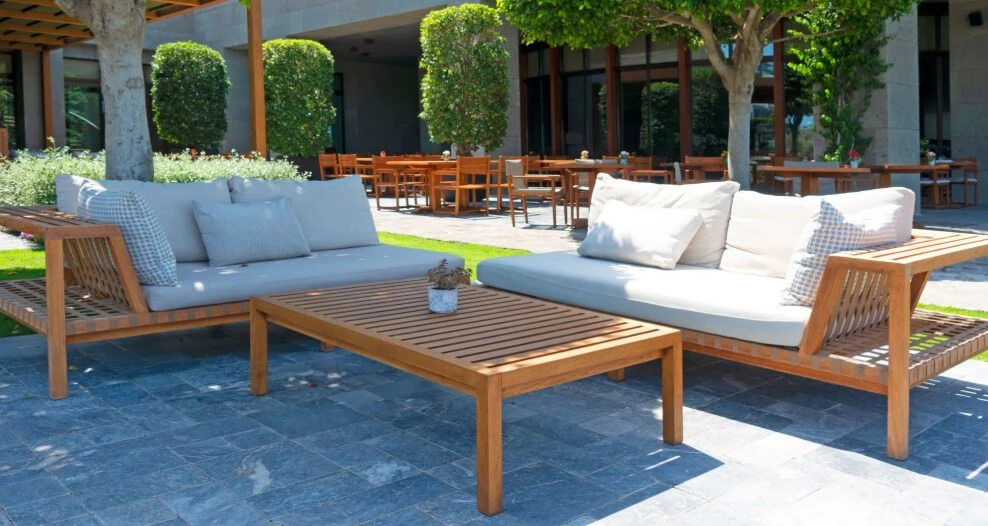
When designing poolside sunbathing layouts, choosing a teak outdoor sofa with adjustable backrest for sun lounging offers multi-position comfort for hotel guests.
Because adjustable backrests rely on concealed stainless steel ratchets and timber hinges, using dimensionally stable plantation teak prevents frame warping, ensuring smooth mechanism operation across seasons.
📦 Commercial Storage & Outdoor Deck Equipment
For resort housekeeping teams, a teak outdoor storage box provides a weatherproof enclosure for sunbed towels, poolside cushions, and maintenance gear.

Because storage boxes feature large flat panels exposed to rainwater, selecting mature plantation teak with low volumetric shrinkage prevents panel warping and ensures watertight protection.
5. Commercial Return on Investment: Teak vs. Synthetic Alternatives
When evaluating material options for major resort installations, procurement officers frequently balance long-term replacement cycles against initial capital expenditure:
⚖️ Long-Term ROI Analysis for Hospitality Furniture
When comparing a teak vs poly lumber outdoor furniture ROI for hospitality, synthetic high-density polyethylene (HDPE) lumber offers lower upfront costs.
However, synthetic poly lumber absorbs thermal radiation in direct sunlight, becoming uncomfortably hot to touch and susceptible to sag under heavy loads.
In contrast, natural plantation teak remains cool in hot sunshine and gradually develops a silver-grey patina that enhances luxury aesthetic value without structural degradation.
6. Financial Analysis: 25-Year Lifecycle Costing for Resort Furniture
Comparing total cost of ownership across common commercial material options illustrates the financial benefits of specifying mature plantation teak:
📊 Commercial Material Lifecycle Cost Matrix (100-Seat Resort Terrace)
| Evaluation Parameter | Grade-A Plantation Teak | Premium HDPE Poly Lumber | Commercial Powder-Coated Aluminum |
| Initial Capital Expenditure | 🔴 Moderate-High | 🟢 Low-Moderate | 🟢 Low-Moderate |
| Expected Commercial Service Life | 🟢 25+ Years | 🟡 6 to 8 Years | 🟡 8 to 10 Years |
| Replacement Frequency (25 Yrs) | 🟢 0 Replacements | 🔴 3 Replacement Cycles | 🔴 2 Replacement Cycles |
| Surface Temperature in Sun | 🟢 Remains Touch-Cool | 🔴 Becomes Scorching Hot | 🟡 Heats Up Quickly |
| Structural Sag Under Weight | 🟢 Zero Creep Sag | 🔴 High Thermal Plastic Creep | 🟢 Zero Sag |
| Total 25-Year Cost Efficiency | 🟢 Lowest Total Cost | 🔴 High Cumulative Cost | 🟡 Moderate Cumulative Cost |
7. Factory Audit Protocol: Verifying Plantation Teak Grade-A Quality
To ensure commercial furniture orders deliver maximum outdoor longevity, procurement directors should mandate this four-step factory inspection protocol prior to shipping:
📋 Quality Assurance Audit Steps
Visual Sapwood Inspection: Inspect raw timber components prior to finishing. Grade-A quality requires zero sapwood presence on exposed frame surfaces.
Digital Moisture Verification: Use a calibrated pin-type moisture meter to confirm internal wood moisture measures strictly between 8% and 12% moisture content.
Annual Ring Count Audit: Examine end-grain cross-sections to verify growth ring density exceeds eight rings per inch, confirming timber was harvested from a mature plantation log.
Legality Certification Audit: Cross-reference timber lot batch codes against valid legal forestry documentation to guarantee environmental compliance.
8. International Timber Standards & Environmental Certifications
Sourcing export-quality outdoor furniture requires verifying compliance with recognized international forest management and quality standards:
🛡️ Essential Industry Certifications
FSC Certification: Forest Stewardship Council certification verifying timber is harvested from responsibly managed plantations that protect biodiversity and local communities.
SVLK Compliance: Indonesia's mandatory timber legality assurance system certifying that all teak logs are legally sourced and traceable.
ISO 9001: International quality management standard governing precision manufacturing, joinery tolerance, and moisture control consistency.
EN 350-2: European standard rating natural timber durability. Grade-A teak heartwood achieves the highest Class 1 Very Durable designation.
ASTM D143: Standard test methods for evaluating small clear timber specimens, measuring janka hardness, static bending strength, and compression parallel to grain.
FAQ:
Q1: Is plantation teak as durable as old-growth teak for outdoor hotel furniture?
When harvested at maturity (thirty to fifty years of age) and processed using Grade-A heartwood, plantation teak provides an outdoor service life of twenty-five to thirty-five years. While virgin old-growth teak possesses higher ring density, mature plantation teak fully meets all commercial hospitality requirements while providing complete environmental compliance and legal security.
Q2: How can buyers distinguish between Grade-A plantation teak and cheap Grade-C teak?
Grade-A teak heartwood features a uniform golden-brown color, oily surface feel, dense grain lines, and zero sapwood. Cheap Grade-C teak is harvested from young trees (under fifteen years old), exhibiting pale yellow cream color, chalky texture, high sapwood ratio, and low oil content. Grade-C teak typically cracks and warps within three years of outdoor exposure.
Q3: Does plantation teak require oiling or sealing to maintain its structural strength?
No, oiling or sealing is purely a cosmetic choice and does not alter the structural strength of Grade-A teak. The timber's internal tectoquinone and natural rubber content protect it against weather decay regardless of surface treatments. Unfinished teak will naturally weather into an elegant silver-grey patina over nine to twelve months when exposed to rain and sun.
Q4: Why is FSC or SVLK timber certification critical for commercial teak procurement?
FSC and SVLK certifications prove that timber originates from legally harvested, sustainably managed plantations. Importing non-certified timber risks severe legal penalties under international laws like the U.S. Lacey Act or EU Timber Regulation (EUTR), while ensuring your brand avoids contributing to illegal deforestation.