

💧 Wood Science & Export Quality Summary: For international commercial buyers, resort developers, and hospitality procurement directors, timber moisture control represents the single most critical factor determining product longevity. While Grade-A teak heartwood is world-renowned for its natural rot resistance, improperly dried timber containing excess capillary moisture will suffer severe shrinkage, warping, surface check splitting, and joint dislocation when shipped across different climate zones. Understanding what is the moisture content threshold for export-quality teak outdoor furniture? reveals that maintaining a strict 8% to 12% moisture content (MC) standard via computer-controlled kiln drying is the universal baseline for premium export manufacturing.

1. The Physics of Moisture in Teak: Free Water vs. Bound Water
To evaluate timber stabilization, quality control engineers distinguish between two distinct forms of water trapped within raw teak logs:
When a fresh teak tree is harvested, its internal wood cells are saturated with moisture, often exceeding 60% to 80% total weight.
Free Water: Liquid water contained inside the open cell cavities (lumens). Removing free water decreases timber weight but causes zero dimensional change or wood shrinkage.
Fiber Saturation Point (FSP): The precise boundary state-typically occurring around 28% moisture content in teak-where all free water has evaporated, leaving only bound water absorbed within the cell walls.
Bound Water: Hydrogen-bonded moisture chemically bound within the cellulose and hemicellulose wall structure. As bound water evaporates below the 28% threshold, cell walls collapse inward, triggering physical timber shrinkage, grain tension, and structural movement.
When commercial buyers ask: what is the moisture content threshold for export-quality teak outdoor furniture?, timber physics dictates that drying must proceed safely past the fiber saturation point down to a stable equilibrium state before cutting, mortising, or joint assembly begins.
2. The Golden Export Threshold: The 8% to 12% Moisture Benchmark
Why is 8% to 12% moisture content universally mandated by international buyers for export-grade outdoor furniture? The answer lies in the concept of Equilibrium Moisture Content (EMC).
Wood is a natural hygroscopic material, meaning it continuously absorbs or releases atmospheric moisture until its internal humidity matches the surrounding environment.
If teak furniture manufactured in humid tropical regions (with 18% timber moisture) is exported to an arid climate like Nevada or Riyadh (where ambient outdoor EMC drops to 7%), the wood rapidly sheds bound water. This sudden evaporation generates extreme internal tension, resulting in jagged surface check cracks and opened mortise-and-tenon joints.
Conversely, kiln-drying teak timber to an average of 10% (±2%) places the material right in the center of global outdoor climatic fluctuations, accommodating both dry inland winters and humid coastal summers without structural distortion.

3. Comparative Matrix: Global Destination EMC vs. Teak Moisture Thresholds
Aligning factory moisture specifications with destination climate zones prevents post-delivery warranty claims and structural joint failures:
📊 Destination Climate vs. Timber Moisture Specifications
| Destination Region | Local Outdoor EMC Range | Ideal Factory Teak Moisture Target | Risk of Using Air-Dried Timber (>16% MC) | Structural Impact on Joinery |
| Arid / Desert (Dubai, Arizona) | 🟢 6% – 9% | 🟢 8% – 9% (Specialized KD) | 🔴 Catastrophic (Severe splitting) | 🔴 Mortise joints loosen completely |
| Temperate / Urban (Europe, NY) | 🟢 9% – 12% | 🟢 9% – 11% (Standard Export) | 🔴 High (Surface checking & warping) | 🟡 Glue lines shear under stress |
| Humid Coastal (Florida, Caribbean) | 🟢 12% – 15% | 🟢 10% – 12% (Standard Export) | 🟡 Moderate (Mild swelling) | 🟢 Joints remain stable |
| Sub-Zero Alpine (Ski Resorts) | 🟢 7% – 10% | 🟢 8% – 10% (Specialized KD) | 🔴 Severe (Freeze-thaw fracture) | 🔴 Ice expansion splits damp joints |

4. Structural Impact Across Commercial Teak Product Lines
Managing moisture thresholds is especially critical when manufacturing complex, multi-material outdoor furniture where wood connects directly to aluminum, steel, or high-performance textiles.
🛋️ Deep Seating & Modular Sofa Architectures
In luxury commercial hospitality projects, an outdoor teak sectional with sunbrella cushions combines expansive teak wood platform frames with weather-resistant upholstered seating.
If the underlying platform beams possess inconsistent moisture levels across modules, individual sections will warp unevenly over time, creating misaligned alignment seams across the patio.
For larger lounge spaces, specifying an outdoor teak sofa set with matching coffee table and ottoman requires precise timber conditioning.
Because coffee table tops feature wide glued timber planks, maintaining an 8% to 12% moisture content ensures that individual wood slats expand and contract uniformly without tearing apart edge-glued seams or causing surface cup distortion.
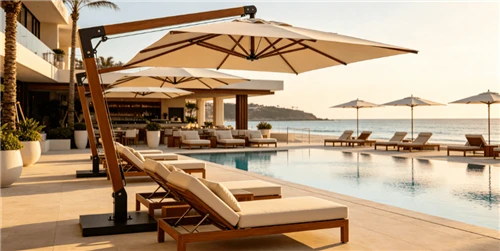
🏊 Heavy-Duty Resort Seating & Poolside Loungers
High-traffic commercial venues require heavy duty teak patio furniture built with oversized 80mm to 100mm structural leg posts. Thick timber cuts present the greatest challenge during kiln drying because moisture inside the core takes weeks to migrate out to the surface.
If core moisture remains high while the exterior shell dries, the timber develops case hardening-a severe internal stress condition that causes dramatic deep splits when holes are drilled for hardware bolts.
Similarly, engineering custom luxury outdoor teak pool loungers with wheels demands absolute structural stability around mobile wheel axles and multi-position backrest ratchets.
Using precision-dried teak prevents leg frames from warping out of alignment, ensuring that integrated wheels roll smoothly across stone decks without binding against the wood chassis.
5. Industrial Dehydration: Kiln Drying (KD) vs. Air Drying (AD)
To consistently achieve export-quality moisture thresholds, manufacturers must rely on automated steam-heated kiln drying facilities rather than natural outdoor air drying.
🛠️ The Four Phases of Precision Kiln Drying
Pre-Steaming Phase: Freshly sawn teak boards are treated with low-pressure saturated steam at 60°C to open wood pores, equalize internal temperature, and relieve natural growth stresses locked in the log.
Controlled Dehydration Phase: Computerized kilns gradually increase temperature while reducing relative humidity. Water is extracted slowly at a controlled rate of 1% to 1.5% moisture reduction per 24-hour cycle to prevent surface checking.
Equalization Phase: Once timber reaches the target 10% average moisture, the kiln climate is held constant for 48 hours to balance moisture variations between the timber core and exterior shell.
Conditioning / Stress-Relief Phase: Saturated steam is briefly reintroduced to soften wood fibers, eliminating lingering drying stresses and stabilizing the wood for precision CNC machining.

6. Manufacturing Comparison: Kiln-Dried (KD) vs. Air-Dried (AD) Teak
Understanding the operational differences between industrial kiln drying and basic outdoor air seasoning helps procurement officers avoid inferior timber processing:
📊 Timber Seasoning Method Comparison
| Processing Feature | Computer-Controlled Kiln Drying (KD) | Traditional Air Drying (AD) | Solar / Hybrid Drying |
| Achievable Moisture Level | 🟢 8% – 12% (Precise & Uniform) | 🔴 16% – 22% (Unpredictable) | 🟡 12% – 16% (Weather Dependent) |
| Drying Time Frame | 🟢 20 to 35 Days (Controlled) | 🔴 6 to 18 Months | 🟡 45 to 60 Days |
| Core-to-Shell Moisture Gap | 🟢 < 1.5% Moisture Variance | 🔴 > 5% Variance (Wet Core) | 🟡 2% – 3% Variance |
| Pest & Larvae Eradication | 🟢 100% Thermal Sterilization (65°C+) | 🔴 Zero Insect Extermination | 🟡 Partial Heat Sterilization |
| Post-Export Joint Defect Rate | 🟢 < 0.5% (Commercial Grade) | 🔴 12% – 25% High Failure Rate | 🟡 3% – 5% Defect Rate |
7. Quality Assurance: Measuring Instruments, Audits, and International Standards
Verifying compliance with the what is the moisture content threshold for export-quality teak outdoor furniture? standard requires rigorous factory quality control protocols using calibrated digital meters.
🛡️ Essential Testing Standards & Certifications
ASTM D4442: Standard Test Methods for Direct Moisture Content Measurement of Wood and Wood-Base Materials (Oven-Dry Laboratory Method).
ASTM D4444: Standard Test Methods for Use and Calibration of Hand-Held Moisture Meters across hardwood species.
ISO 9001: Quality Management Systems governing batch tracking and moisture inspection records across all production steps.
FSC Chain of Custody (CoC): Verifies that kiln-dried timber originates from sustainably managed, legally harvested plantations.
SVLK Timber Legality: Indonesia's mandatory timber legality verification system ensuring transparent supply chain tracking.
EN 350-2: European standard certifying natural timber durability ratings (Grade-A teak heartwood achieves Class 1: Very Durable).
8. Quality Assurance Checklist: Factory Moisture Control Verification
To ensure export consignments meet global moisture standards, procurement directors should require suppliers to complete this verification protocol before loading containers:
📋 Pre-Shipment Moisture Control Protocol
| Quality Control Checkpoint | Testing Method & Tool | Compliance Benchmark | Failure Action Plan |
| Raw Board Intake | Pin-type Resistance Meter | 12% – 14% Pre-Machining | Return to drying kiln |
| Post-CNC Component Check | Non-destructive Pinless Scanner | 8% – 12% Across All Points | Reject non-conforming batch |
| Core Moisture Audit | Deep Pin Probe on Sample Cut | Core vs. Shell Gap < 1.5% | Re-condition in drying kiln |
| Pre-Packing Random Scan | 10% Random Sampling per Order | Zero Readings > 12% MC | Hold container loading |

9. Ocean Transport Risks: Container Sweat and Moisture Microclimates
Achieving an 8% to 12% timber moisture level during manufacturing is only half the battle. During 30 to 45 days of ocean transit across varying temperature zones, sealed shipping containers experience severe condensation known as container sweat.
🚢 Preserving Low Moisture During Sea Freight
High-Absorption Desiccant Bags: Placing calcium chloride desiccant poles inside shipping containers absorbs airborne moisture, keeping relative humidity below 60%.
VCI Moisture-Barrier Wrapping: Sealing individual teak furniture items inside breathable, water-impermeable protective wrap prevents surface water absorption during sea transit.
Controlled Pallet Moisture: Ensuring wood shipping pallets and cardboard packaging materials have a moisture content below 12% prevents secondary humidity generation inside sealed containers.
FAQ:
Q1: Why does teak outdoor furniture dry out and check even when kiln-dried to 10% moisture content?
Small hairline surface cracks (known as surface checks) are a natural characteristic of dense hardwoods when exposed to direct sunlight and sudden humidity shifts. Even when timber is perfectly kiln-dried to 10% moisture, the outermost wood cells expand and contract faster than the inner core when exposed to rain or intense UV rays. Hairline surface checks do not compromise the structural integrity of Grade-A teak heartwood and often close naturally as ambient humidity balances out.
Q2: Can a non-destructive pinless moisture meter provide accurate readings on dense teak timber?
Yes, high-frequency digital pinless moisture meters provide accurate, non-destructive surface and sub-surface moisture readings up to 20mm deep. However, for dense tropical hardwoods like teak, the meter must be correctly calibrated for the specific species density (teak specific gravity is approximately 0.55 to 0.65). For thick structural leg posts exceeding 50mm, quality assurance inspectors should supplement pinless scans with insulated pin-type probe measurements on freshly cut ends to verify true core moisture.
Q3: What happens if teak furniture manufactured at 18% moisture is shipped to a dry desert climate like Dubai or Nevada?
If teak containing 18% moisture is delivered to an arid environment with 6% to 8% ambient equilibrium moisture, the wood loses internal bound water rapidly. This extreme moisture gradient creates severe tensile stress across the grain, resulting in wide structural splits, warped table tops, and loose mortise-and-tenon joints within 30 to 90 days of installation.
Q4: Is air-dried (AD) teak acceptable for outdoor furniture if allowed to season naturally for two years?
While extended air drying can reduce raw timber moisture down to 15%–18% in humid tropical climates, air seasoning alone can never lower timber moisture below the ambient outdoor humidity of the manufacturing country. Because tropical humidity rarely drops below 70% (corresponding to an ambient wood EMC of ~15%), air-dried teak remains too damp for export to drier temperate or desert markets without secondary kiln drying.