


Every square foot on a commercial outdoor patio represents revenue potential.
Yet hospitality operators often overlook how shade structures compromise floor plans.
When choosing between shade styles, floor clearance quickly becomes your biggest operational bottleneck. A traditional Market Patio Umbrella requires a dedicated hole through the center of a table or a bulky central base that splits adjacent seating clusters.
When servers carry hot plates through narrow dining aisles, central bases create tripping hazards and reduce clearance width. Moving to an offset mast layout frees up unobstructed pedestrian pathways.

📊 Spatial Efficiency & Walkway Impact Comparison
| Spatial Parameter | Center Pole System | Cantilever Offset System |
|---|---|---|
| Center Floor Obstruction | High (Base & pole occupy prime legroom) | Zero (Mast sits completely outside table boundary) |
| Aisle Clearance Width | Restricted by base diameter | Unobstructed edge-to-edge service pathways |
| Layout Modular Agility | Fixed (Tables locked around pole hole) | Dynamic (Tables push together or reconfigure freely) |
| Walkway Safety Rating | ⚠️ Moderate trip risk in high-density areas | 🛡️ High safety (Bases flush against perimeter) |
🪑 Seating Density Matrix: Table Configuration Flexibility
How many covers can your patio handle during peak weekend brunch?
If your tables are locked around fixed central posts, joining two 2-top tables into an 8-person banquet layout becomes an engineering puzzle.
Offset canopy systems hover above dining spaces. This allows floor managers to rearrange tables beneath a continuous canopy of commercial patio shade without bumping into aluminum posts.
Furthermore, pairing cantilever shade with flexible seating like an outdoor sectional sofa creates an upscale lounge atmosphere that standard market umbrellas simply cannot accommodate.
For night dining and evening cocktail hours, integrated LED systems like a Solar Patio Umbrella eliminate wires across walkways, boosting ambiancy while keeping foot paths clear.

📊 Seating Capacity & Layout Flexibility Benchmarks
| Commercial Requirement | Standard Center Pole | Heavy-Duty Cantilever | Commercial Advantage |
|---|---|---|---|
| Table Merging Capability | Poor (Poles block table-to-table alignment) | Excellent (Continuous canopy cover) | ➕ 20% to 30% higher banquet capacity |
| Booth / Sofa Alignment | Difficult (Cannot overhang deep furniture) | Seamless (360-degree rotation overhang) | Unlocks premium perimeter lounge seating |
| Shade Adjustability | Fixed tilt angles | Multi-angle canopy tracking | Protects guests as the sun drops lower |
🌬️ Structural Stability & High Wind Engineering
Patio shade must withstand sudden coastal gusts and urban wind tunnels without risking guest safety or property damage.
Choosing a Wind Resistant Patio Umbrella requires evaluating the frame geometry and stress points. A center pole transfers wind loads vertically down its central spine, making it inherently stable in mild breezes but rigid.
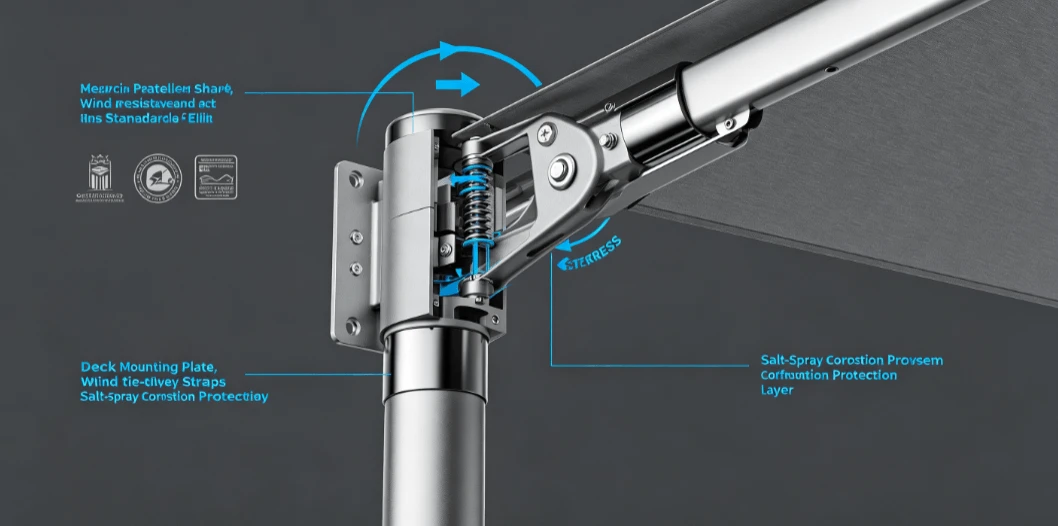
Conversely, cantilever arms act as levers against wind force. They require structural heavy-weight engineering, specialized joints, and marine grade 316 stainless steel umbrella hardware to prevent salt spray corrosion and joint fatigue in seaside installations.
To ensure stability during severe weather, high-end commercial properties pair cantilever systems with a high wind tie down kit for hotel umbrellas, securing the canopy ribs directly to anchored deck plates.
📊 Structural Engineering & Weather Resistance
| Engineering Factor | Center Pole Setup | Cantilever Setup | Structural Requirement |
|---|---|---|---|
| Wind Load Distribution | Downward axial thrust | Rotational leverage & shear stress | Needs reinforced heavy-duty ribs |
| Corrosion Resistance | Standard anodized finish | ASTM B117 salt-spray tested hardware | Essential for coastal venues |
| Anchoring Method | Surface base / In-ground sleeve | Heavy weight ballast / Deck mounting | Minimum 120kg ballast or direct bolting |
| Safety Tie-Down Options | Standard rib straps | Dedicated wind stabilizer straps | Prevents canopy sway in 35+ mph gusts |
📋 Material Standards & Industry Certifications
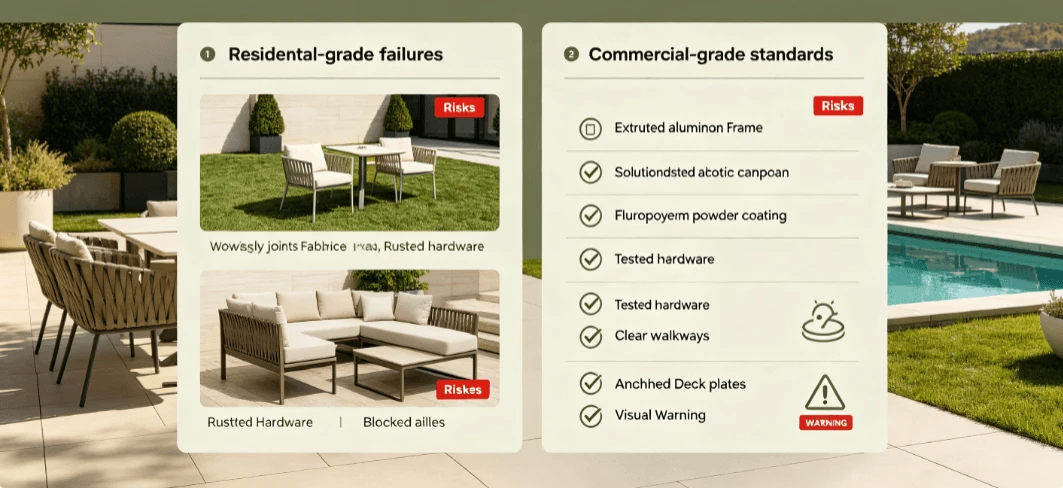
When procuring commercial shade equipment at scale, residential-grade materials will fail within months. Hospitality buyers should demand documented testing certificates before issuing purchase orders.
Look for structural skeletons built with extruded aluminum frames treated with a durable fluoropolymer powder coating to resist chipping, UV degradation, and humidity.
Canopy fabrics should utilize 100% solution-dyed acrylic fabric to maintain color fastness under brutal sunshine.
🛡️ Verified Testing & Certification Standards
TÜV Rheinland: Verifies mechanical load limits, hinge safety, and structural integrity under cyclic stress.
ISO 9001: Guarantees factory quality management consistency across large volume manufacturing runs.
GREENGUARD Gold: Ensures low chemical emissions from fabrics and coatings for indoor/outdoor dining safety.
OEKO-TEX Standard 100: Certifies canopy textiles are free from harmful heavy metals and toxic chemicals.
NFPA 701: Essential fire-retardant certification required by municipal commercial building codes for public dining areas.
❓ FAQ
Q1: How does a cantilever umbrella increase outdoor seating capacity compared to a center pole model?
By moving the support pole and heavy base to the outer perimeter of your patio, cantilever umbrellas eliminate floor-level obstructions. This allows tables to be placed closer together, frees up server aisles, and enables flexible table reconfigurations that can increase total seat count by 15% to 25%.
Q2: Are cantilever umbrellas safe to use in high-wind commercial dining environments?
Yes, provided they are engineered specifically for commercial use. Look for heavy-gauge aluminum frames, stainless hardware, heavy ballast mounts, and specialized wind tie-down kits. Commercial units tested under wind tunnel conditions can safely withstand high wind loads when properly anchored.
Q3: What fabric certifications should I look for when purchasing restaurant patio umbrellas?
Always request NFPA 701 (fire retardancy for commercial codes), OEKO-TEX Standard 100 (textile safety), and GREENGUARD Gold (low chemical emissions). The fabric should be solution-dyed acrylic to prevent UV fading.
Q4: Which umbrella base mounting method is best for a busy hotel or restaurant terrace?
In-ground concrete anchors or surface-bolted deck plates are ideal. They eliminate large above-ground weight bases, eliminating tripping hazards for guests and servers while maximizing usable floor space.
Q5: Can cantilever umbrellas rotate to shade multiple tables throughout the day?
Yes. Quality commercial cantilever umbrellas feature 360-degree pedal rotation and multi-position tilt mechanisms. This allows a single umbrella to shade different seating areas as the sun moves, reducing the total number of shade units required on your terrace.
Q6: How do marine-grade hardware components extend the lifespan of commercial shade units?
Hardware made from 316-grade stainless steel resists pitting, rust, and salt spray oxidation significantly better than standard 304 steel or zinc-plated fasteners, drastically reducing maintenance cycles in coastal or poolside environments.
Q7: What is the average return on investment (ROI) when upgrading to perimeter-mounted shade?
Because offset shade frees up floor clearance, most venues can add at least 1 to 2 extra dining tables. In a busy commercial restaurant, the revenue generated from those additional seats typically covers the procurement cost of the umbrellas within the first operating season.
Q8: What maintenance schedule is required for commercial cantilever shade systems?
Perform a monthly visual inspection of hardware torque, clean canopy fabrics with mild soap to prevent mold spores from setting, inspect wind tie-down straps, and ensure rotational bearings are properly lubricated. During winter or storm seasons, store canopies in protective commercial covers.


