
Quick Summary
Choose outdoor furniture for a resort or B&B by starting with how guests use each space and how staff prepare it, then match the complete product to the site conditions, care routine, storage and design intent. A resort may manage several dedicated outdoor areas, while a small inn may depend on one flexible patio; neither property label alone predicts how intensively its furniture will be used.
Outdoor furniture shapes the way guests arrive, eat, rest and spend time between activities. In a resort, the outdoor experience may stretch across pool decks, restaurants, garden lounges, beach settings and guest terraces. At a bed-and-breakfast or small inn, one courtyard might serve breakfast, reading and evening conversation. The right selection process needs to account for those differences without assuming that every resort is high-volume or every inn is quiet.
A product that looks right in a design presentation may still create a difficult daily routine. Cushions may need a storage location; chairs may need to travel through narrow doors; a table may be hard to clean around; or the intended arrangement may not leave enough room once guests pull seats out. These are not minor details to solve after the order. They affect which furniture belongs in a setting and whether the property can keep it ready for use.
Effective resort outdoor furniture selection starts with an operating description, not a material label or catalogue category. Decide what the guest should be able to do, who will set and care for the furniture, and which site conditions matter. Then assess the proposed product, sample and evidence against those needs. This approach helps a resort coordinate many outdoor settings and helps a small lodging property avoid buying more complexity than its team can manage.
1. Separate property scale from operating intensity
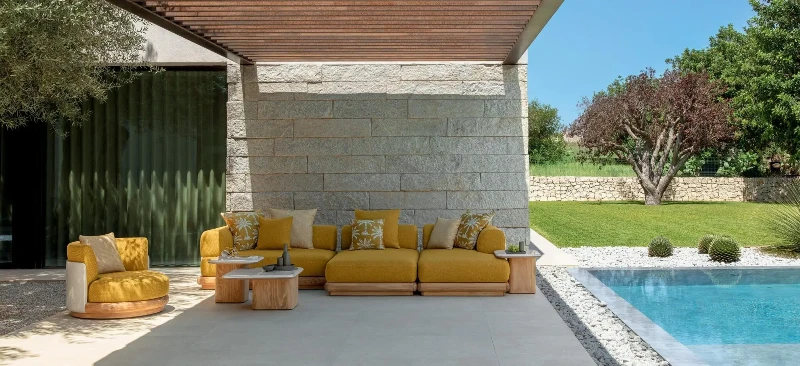
Outdoor furniture for resorts may serve many separate spaces, while outdoor furniture for B&Bs may be concentrated on a porch, courtyard or garden. Those patterns can shape staffing and service, but the actual workload depends on how the property operates. A small inn may host outdoor breakfasts and private events every day; a large resort may include quiet spaces with limited movement. Record the real operation before deciding that one property needs "commercial" furniture and the other can use a residential product.
| Decision factor | Multi-zone resort may need to resolve | B&B or small inn may need to resolve | Selection consequence |
|---|---|---|---|
| Concurrent activities | Dining, pool use, events and guest lounging may happen in different areas at the same time. | A single patio may change purpose between breakfast, daytime relaxation and evening use. | Decide which furniture is permanently assigned and which items can be shared without double-counting them. |
| Staff ownership | Pool, food service, housekeeping, events and grounds teams may have separate responsibilities. | A small team or owner may manage setup, cleaning and guest support together. | Confirm who will move, clean, inspect and store each group before choosing a handling routine. |
| Guest turnover | Several service periods or activity changes may affect the same furniture. | A small number of rooms can still create frequent table resets or event turnover. | Estimate use from the operating schedule, not room count or property category alone. |
| Storage and access | Furniture and event stock may compete for shared back-of-house space. | Storage may be limited, far from the patio or shared with household supplies. | Measure the storage route and space for the exact folding, stacking or cushion plan. |
| Design role | A coherent guest experience may need to connect several visibly different settings. | A porch or garden may be a defining part of the property's identity. | Select a small set of shared visual cues, then allow product form to follow the activity. |
| Replacement approach | Procurement may track models and quantities by building or zone. | The owner may need to replace individual pieces without creating a large spare inventory. | Preserve exact model, finish and fabric references; do not assume future matching is guaranteed. |
Use this comparison to start a conversation with the people who run the property. It is not a universal resort-versus-B&B specification. Before shortlisting products, ask the operator to describe a normal day, a busy day and the tasks that happen when weather or an event changes the plan. That conversation often identifies whether the key constraint is space, storage, staff time, appearance, guest comfort or continuity of replacement pieces.
2. Follow a guest day through the outdoor spaces
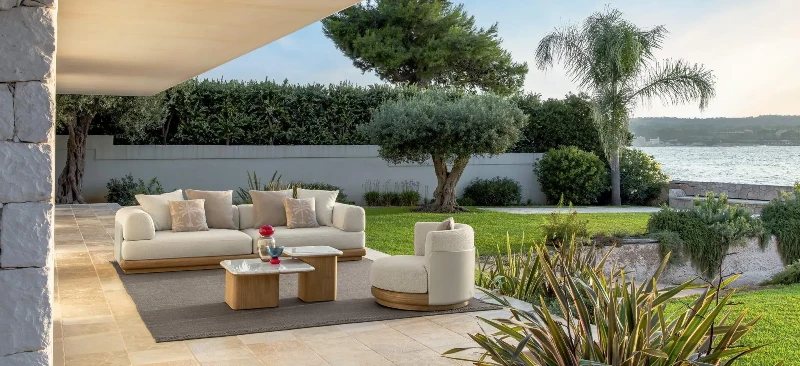
A property plan identifies locations; a guest-and-staff walkthrough explains what happens there. Follow the guest journey from arrival to departure and note where furniture supports a pause, a meal, conversation, privacy or activity. Then follow the team that opens, services and closes each area. This catches situations that a product-first list can miss, such as the same courtyard needing to be ready for breakfast and then cleared for a private gathering.
| Moment in the guest day | What to observe | Why it changes the furniture decision | Who should review it |
|---|---|---|---|
| Arrival or check-in | Whether guests wait, stand with luggage, meet a host or move straight to their room | A brief waiting spot has different seating and table needs from a destination lounge. | Front desk or host, designer, operations lead |
| Breakfast or dining | Meal duration, table arrangement, service path, clearing and cleaning | Chair-table fit, pull-back space and reset routine matter as much as the appearance of an isolated chair. | Food service, housekeeping, design |
| Midday relaxation | Shade pattern, quiet zones, pool or garden use, guest belongings | Furniture placement and surfaces should support the actual activity and the site's exposure. | Grounds or pool staff, operator, design |
| Changeover or event | Which pieces move, where they go, who approves the layout and what happens to guests already seated | Shared inventory works only when the timing, storage route and alternate guest arrangement are realistic. | Events, operations, housekeeping |
| Evening use and closing | Whether guests dine, read or gather; what is cleaned, removed or covered | The final presentation and storage plan should match the staffing and care instructions. | Host or food service, closing team |
This is not a requirement to create a complex operating manual. A small property may need only a short note that breakfast ends before the courtyard becomes a guest lounge. A resort may need separate operating notes for areas managed by different teams. The useful output is a clear answer to three questions: what is the area for now, what will change next, and who prepares that change?
Do not count one location as supporting two simultaneous uses unless the layout and service plan can accommodate both. If tables will be added for an event, note whether guests using the lounge must move and who communicates that change. If loungers are shared with another pool zone, document how staff know they are available. Furniture quantity cannot resolve a conflict in space or service by itself.
3. Test the routine with the staff who will do it
For every movable piece, trace the complete handling cycle: retrieve it, carry or wheel it, place it, inspect it, clean it, prepare it for guests, remove it when needed and return it to its storage location. Include cushions, umbrellas or side tables if the operating plan depends on them. A product may be comfortable and attractive but create an unrealistic routine if it needs frequent movement and the team has no suitable storage route.
At a B&B, ask the person who will prepare breakfast or close the patio to try the proposed setup. At a resort, ask the relevant pool, housekeeping, food-service or event team to demonstrate the movement they would perform. A chair described as lightweight may still be awkward to grip; a stackable chair may require a specific arrangement; a cushion may need to be brought indoors after cleaning. Only the exact product instructions and an actual handling review can settle those questions for a project.
Check the route as well as the furniture. Can the item pass through the door, corridor, lift or gate used by staff? Does it fit in the intended store without blocking equipment or another team's supplies? Can the team retrieve it without unloading other items first? If the property expects guest movement, consider where a chair could be repositioned and what the feet may contact. Record any required trolley, glide or storage accessory as part of the proposed configuration rather than assuming it will be available later.
The service routine may change the balance between comfort and simplicity. Removable cushions may suit a lounge concept but add tasks for bringing them out, drying them and storing them. A fixed or integrated seat may reduce handling while being less adaptable to a different guest activity. Neither is automatically better. Compare the guest benefit with the work that the actual team can complete during each operating period.
A useful test can be informal: set up a representative sample in the intended area, ask staff to perform the normal reset, and record where they pause or need help. If the sample is unavailable, use exact dimensions and product instructions as a preliminary review, then keep the handling decision open until a representative trial can be made. Do not convert a marketing description into an operating assumption.
4. Match the full product to the site, not just its material name
Terms such as aluminum, steel, teak, resin, woven, rope or outdoor fabric describe broad materials or constructions. They do not establish how a finished chair, table or sofa will behave in every location. Frame geometry, joints, surface finish, fasteners, seat construction, upholstery, cushion assembly, glides and care instructions all contribute to the final product.
Write down relevant exposure separately for each setting. A coastal terrace, a covered courtyard and a poolside table may face different combinations of sun, rain, salt, splash, food, sunscreen, dust and cleaning products. Ask the product maker what the proposed model and finish are intended to handle and what care limitations apply. Avoid claiming that a material is universally suitable for the property just because the category is commonly used outdoors.
Review the complete assembly in context. A chair frame and a fabric seat may have separate maintenance requirements. A table's edge and base affect how it is cleaned and how guests sit around it. Feet must be considered against the actual paving or deck. A fabric swatch does not tell the whole story of the cushion: ask for care instructions for the supplied cushion construction and confirm how it is dried or stored under the property's routine.
If a timber look or natural finish is important, agree what appearance the property expects over time. Does the design brief accept visible weathering, or does it expect the original color to be maintained? Obtain the maker's care instructions for the actual finish. Similarly, a coated frame should be reviewed for the supplied finish, touch points and any approved repair method. Do not prescribe a generic oil, cleaner, sealant or coating repair for an unidentified product.
The material comparison in Howvin's restaurant patio furniture materials guide can help readers examine trade-offs between materials and finished components. For a resort or inn, use those distinctions as questions for the shortlist; the exact model, construction and care documents still determine whether a proposed combination suits a particular site.
5. Make comfort and layout fit the stay
A breakfast chair, a lounge seat and a sun lounger support different activities. Review each with the table or side surface, surrounding floor, shade and expected length of use. Ask people with different needs to try the sample where practical. Check sitting down and standing up, back and arm position, seat depth, chair pull-back, access to a table and movement around the occupied setting.
For a small inn, guests may use a patio as an extension of their room: coffee in the morning, a quiet place to read or an evening conversation. The property may want fewer pieces and more privacy between seats. At a resort, guest groups may move between dining, pool, beach and event settings. These are design possibilities, not assumptions about every traveler. Use the property's concept and actual guest activities to decide what needs to feel intimate, social, flexible or easy to find.
Review the layout when seats are occupied and belongings are present. A chair pulled away from a breakfast table occupies more room than the plan symbol. A suitcase near a balcony seat, a service tray beside the table or a queue at a host point changes circulation. Confirm accessibility and local layout requirements with the project's qualified designer. Rules vary by country, building type and alteration scope; this article cannot certify a site arrangement.
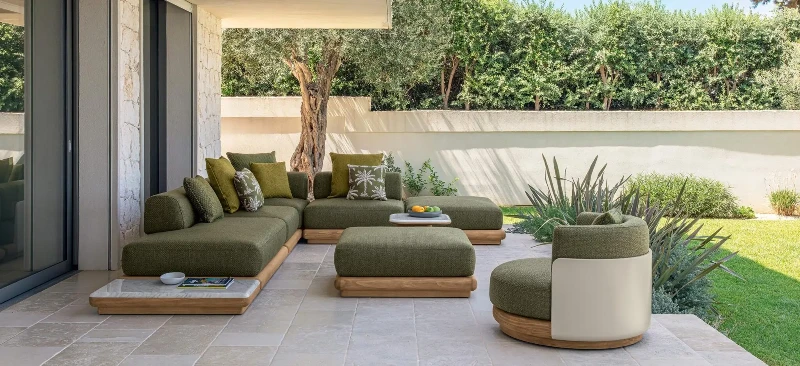
A consistent style does not require identical products. The property can repeat color, material accents or shape while choosing separate forms for dining, pool, garden or balcony use. Document the shared cues and acceptable differences. This is particularly useful in a small property where the garden may be the visual signature, and in a resort where many distinct settings still need to feel related.
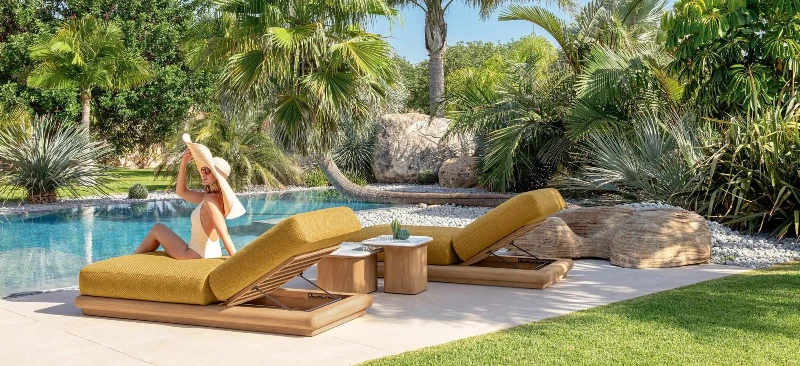
When dining is part of the brief, explore commercial outdoor dining furniture after the intended service and layout are clear. For resort pool furniture or beach-area seating, browse commercial pool sunloungers after recording the local conditions and handling plan. These series pages help build a shortlist; they do not certify the suitability or performance of an individual model.
6. Decide what inventory should be dedicated, shared or held in reserve
The scale of the property does not determine whether it needs dedicated or shared furniture. That choice depends on simultaneous activity, changeover time, storage access, staff and the cost of having a setting unavailable. A resort may share some event chairs between areas but need separate pool furniture during peak service. A B&B may keep breakfast chairs dedicated and use a separate pair of lounge seats so guests do not have to wait for the patio to be reset.
| Inventory approach | When it may fit | What to verify first | Main trade-off |
|---|---|---|---|
| Dedicated by area | Several activities operate at once or a setting must stay ready. | Confirm the activity, quantity and storage or maintenance owner for that zone. | More pieces to purchase and manage, but less competition between simultaneous uses. |
| Shared across uses | The same area changes purpose at known times and a team can reset it. | Confirm the transition window, storage path, approval role and guest communication. | Can reduce duplicated stock, but depends on a reliable changeover. |
| Event or seasonal reserve | Demand varies or a property changes its layout for defined periods. | Identify where reserve pieces live and who authorizes deployment. | Adds storage and handling; availability cannot be assumed if stock is already assigned elsewhere. |
| Repair or replacement spares | A missing component or unavailable seat would disrupt operation. | Identify replaceable components, model references, storage and contractual supply terms. | Stock ties up budget and space; choose it based on service impact rather than an arbitrary ratio. |
Do not label shared furniture as "available" if it is already committed to another area at the same time. Keep a baseline arrangement and any approved alternate arrangement distinguishable. A small inn may document this with a short written note; a resort may use a zone plan and an assigned inventory owner. The form can differ, but the decision should be findable when the regular manager is away.
Replacement planning also differs by scale. A resort may need model and finish records by zone or building. A B&B may need a clear order reference and a practical method for replacing one chair or cushion. In either case, ask what identifiers the supplier uses and whether a future availability commitment is contractual. Do not promise exact batch matching without written confirmation.
For maintenance and lifecycle inputs, Howvin's separate article on evaluating low-maintenance outdoor furniture costs discusses comparing care tasks, staff input and replacement assumptions. Apply that thinking to the actual property: record known costs, estimates and open questions separately instead of assuming a material label predicts ownership cost.
7. Approve the exact sample and evidence
A sample review should identify exactly what is being approved: product model, revision, dimensions, finish, fabric, cushion, table base, accessories and intended zone. Record the reviewers, date, decision and any conditions. If a physical sample is not available, drawings and finish samples can support early review, but state what still needs to be checked in a representative configuration before the order is released.
Separate appearance approval from operational or technical review. A designer may accept a color while operations still needs to test the handling routine. A table may look right while the base reduces usable legroom. A replacement textile may match visually but have different care instructions. Record who signs off each point and what change requires a renewed review.
BSI lists BS EN 581-2:2026 for mechanical safety requirements and test methods for outdoor seating for camping, domestic and contract use. BSI also lists BS EN 581-3:2026 for outdoor tables; its stated scope includes general and structural safety, with strength, reliability and stability. These references help a project team ask which applicable report covers a proposed model.
A standard title or a supplier statement is not proof that a particular item passed. Ask for the actual report and verify its edition, model identity, configuration and stated result. These standards do not by themselves establish resistance to ageing or degradation, upholstery performance, cleaning compatibility, accessible site layout or suitability for every resort and B&B environment. The responsible project specifier should identify the applicable standard and local requirements for the market.
Before approving the order, reconcile the sample decision with the quote and product schedule. Identify quantities by use, included accessories, documents received, care instructions, delivery and assembly scope, any substitutions and open decisions. If the project changes a frame finish, textile or cushion after approval, check whether the change affects appearance, care or supporting evidence.
8. Two hypothetical operating examples
These examples are fictional and are included to demonstrate the decision method. They do not describe Howvin projects, measured operating data or product recommendations.
A garden B&B. The courtyard hosts breakfast and remains open for guests later in the day. The owner asks the breakfast lead to show the reset using the proposed dining table and chairs. They mark where cushions can be stored, how guests with luggage reach the garden door and whether a quieter seating corner is needed. The property chooses only after the operator confirms the proposed care routine and the designer reviews the layout. It may use separate dining and lounge pieces even though the courtyard is small, because the uses and service expectations differ.
A resort with a pool and dining terrace. The team records which pieces must remain by the pool while breakfast and evening dining are serviced elsewhere. It identifies any furniture proposed for shared event use and confirms where it will be stored between settings. The pool shortlist and dining shortlist are reviewed separately, with shared colors or details used to connect the design. A procurement lead asks for the documents tied to each model instead of assuming that one category-level claim covers the entire order.
The method is similar: map use, test the operation, evaluate the complete product and record approval. The inventory and product choice can differ. That is the central distinction: choose for the property's real guest-and-staff routine, not its category name.
Safety Constraints & What NOT to Do
WARNING: Do not position, anchor or modify furniture based only on a catalogue image or this general article. Safe placement depends on the site, product instructions, surface, circulation and applicable local rules. Have qualified project professionals review accessible routes, egress, wind exposure, parasols or shade structures, pool areas and any fixing before installation. If the product instructions or site conditions are unknown, leave the installation decision open until the responsible reviewer confirms it.
Do not treat a mechanical test report as proof of weathering, fire performance, accessibility or suitability for every lodging use. Check the report's actual scope and confirm applicable local requirements. Do not use a cleaner, stacking method, anchoring detail or modification that the product maker has not approved for the supplied model.
Practical Pitfalls
Using resort/B&B as a proxy for use intensity: document actual schedules, guest turnover and staff workload.
Buying a coordinated set for every setting: repeat a design language but select forms for their intended use.
Assuming a shared patio can serve two uses at once: prove the changeover timing and alternate guest arrangement.
Ignoring the person who resets the furniture: involve the staff member who will move, clean or store it.
Choosing from material names alone: compare the complete frame, finish, fabric, fasteners, feet and instructions.
Approving appearance only: record operational, layout and evidence sign-offs separately.
Treating a standard reference as universal proof: verify the report and its exact scope.
Buying spare stock without a reason: connect reserves to storage, repairability and service impact.
Relying on assumed future availability: keep identifiers and confirm any continuity terms in writing.
FAQs
Should a small B&B choose residential outdoor furniture instead of commercial furniture?
The label alone does not decide suitability. Confirm that the written terms permit the intended business use, then review the exact construction, care instructions, warranty scope and handling routine. A small property can host frequent breakfast service or events, so describe the real use before comparing options.
Does a resort need the same outdoor furniture in every area?
No. Pool, dining, garden, beach and balcony areas can have different activities, exposure and staffing. A resort may coordinate colors or design details while selecting different product forms for each use. Approve each configuration against its own layout and care requirements.
What should a lodging property request before approving a furniture sample?
Record the model, revision, dimensions, finish, fabric, cushion and included accessories. Request product-specific care instructions, warranty terms and any test report required by the project. Identify who reviewed appearance, handling, layout and technical evidence; revisit approval if the proposed configuration changes.
How should an owner compare furniture with different maintenance demands?
Compare the care steps, staff time, storage, supplies, repair options, replacements and possible periods when the area is unavailable. Use the same service assumptions for each option, and separate known prices from estimates. "Low maintenance" or a material name cannot determine total cost by itself.