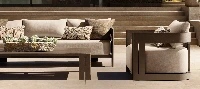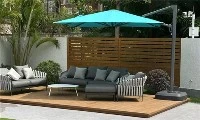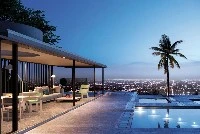

🛡️ ENGINEERING SPECIFICATION CALLOUT Commercial pool deck environments present a unique combination of airborne chemical attack and severe atmospheric humidity. Water splattered from chlorinated pools continuously releases volatile hypochlorous acid and chloramine micro-aerosols into the immediate ambient zone. When standard commercial metal seating is deployed in these zones, unconditioned surface treatments fail prematurely, causing powder coat blistering, severe intergranular rust bleeding, and structural joint compromise. This technical guide details the metallurgical, chemical, and manufacturing methodologies required to prevent powder-coating flaking and rust bleeding on commercial outdoor metal furniture. Incorporating high-performance sectional outdoor furniture around open decks requires strict adherence to material science. Furthermore, shading structures like a poolside pergola with shade or a modern pool pergola with retractable roof drastically reduce localized surface temperatures, slowing down chemical reaction rates on underlying metal hardware.

The Corrosion Chemistry of Chlorinated Resort Pool Environments
Chlorinated resort swimming pools require continuous chemical sanitization, typically maintaining free chlorine levels between 1.0 and 3.0 ppm alongside stabilized pH ranges. As bathers splash water onto surrounding deck areas, water evaporates, leaving behind concentrated sodium hypochlorite and calcium hypochlorite salts on nearby furniture frames.
This chemical concentration establishes an aggressive electrolyte layer on metal surfaces. When moisture reaches the bare metal substrate through atmospheric micro-voids or microscopic mechanical scratches in low-tier paint, an active electrolytic cell forms.
🔬 LABORATORY CORROSION MECHANISM In standard carbon steel or poorly pre-treated aluminum, oxidized chlorine ions act as catalysts that accelerate sub-film oxidation. This phenomenon-known as filiform corrosion-grows laterally beneath the organic coating layer. As iron oxide or aluminum hydroxide molecules expand, they generate internal osmotic pressures that can exceed 20 MPa. This pressure directly shears the physical bond between the organic powder layer and the substrate, manifesting externally as paint flaking, edge blistering, and localized orange rust staining across pool decks.
When hospitality managers source hotel poolside furniture sets, failing to evaluate these chemical micro-environments leads to rapid capital loss. Without engineered surface pre-treatments, high-end commercial properties risk immediate aesthetic degradation and safety hazards.
Substrate Engineering: Alloy Selection for Zero Rust Bleeding
To permanently prevent powder-coating flaking and rust bleeding, engineering teams must evaluate the underlying base metal before applying any topcoat. Ferrous metals, such as cold-rolled steel or wrought iron, possess inherent chemical instabilities when exposed to chloride ions. Even with electroplated zinc undercoats, steel frames eventually exhibit localized oxide expansion at structural joints, leading to noticeable rust weeping over high-end pavers.
Selecting non-ferrous, structural-grade aluminum alloys completely eliminates iron oxide formation. However, distinct structural grades offer varying degrees of natural corrosion resistance and mechanical resilience around busy commercial pool decks.
| Substrate Material Grade | Chemical Composition Highlights | Tensile Strength (MPa) | Corrosion Resistance Index | Commercial Pool Deck Suitability |
|---|---|---|---|---|
| Raw Carbon Steel | High Fe, Low Alloy content | 300–450 | Extremely Low |
Unsuitable; High rust bleeding risk |
| Hot-Dip Galvanized Steel | Fe substrate with Zn shell | 350–500 | Moderate | Marginal; Edge flaking occurs at weld seams |
| 6063-T5 Extruded Aluminum | Mg-Si alloyed architectural frame | 180–220 | High |
Excellent; Ideal for sleek lounger profiles |
| 6061-T6 Structural Aluminum | High Mg-Si-Cu structural grade | 290–310 | Superior |
Industry Standard; Ideal for heavy commercial frames |
Using high-grade 6061-T6 aluminum alloy or 6063-T5 extruded aluminum ensures that even if severe physical impacts score the outer powder layer down to raw metal, the exposed surface forms a self-passivating, non-staining aluminum oxide film rather than loose, bleeding rust.

Multi-Stage Pre-Treatment: The Foundation of Powder Adhesion
Powder coating flaking rarely stems from a defect within the powder compound itself; in over 85% of commercial failures, mechanical delamination is caused by inadequate substrate pre-treatment. Applying thermosetting powder directly onto raw extrusions allows residual extrusion oils, ambient dust, and native aluminum oxidation layers to block full chemical bonding.
To create an unbreakable interfacial bond that withstands continuous pool chemical vapor exposure, commercial aluminum frames must undergo a rigorous multi-stage immersion or power-spray pre-treatment line:
Alkaline Degreasing & Cleaning: Removal of synthetic drawing lubricants, processing oils, and organic surface contaminants using heated alkaline solutions.
Deionized Water Cascade Rinsing: Neutralization of residual alkaline chemistry using ultra-pure deionized water to eliminate rinse-water mineral deposits.
Acid Etching and Deoxidizing: Controlled removal of natural, non-uniform aluminum oxides to establish a uniform surface profile.
Chromate-Free Zirconium Pre-Treatment: Application of a high-technology chromate-free zirconium pre-treatment conversion layer. This dense, nanoscale organo-metallic film chemically anchors to the aluminum lattice, raising surface energy and providing continuous microscopic corrosion barriers.
Dry-Off Oven Conditioning: Drying at controlled temperatures to ensure zero residual moisture remains trapped within micro-pores prior to powder application.
Properties specifying complete outdoor dining or lounge layouts require verified pre-treatment compliance to eliminate subterranean moisture migration and premature coating separation.

Advanced Powder Coating Specifications: AAMA 2605 vs. QUALICOAT Class 3
Selecting the correct organic powder finish is essential for maintaining long-term aesthetic integrity under harsh solar radiation and chemical exposure. Standard commercial furniture often utilizes basic polyester powder coatings conforming to basic AAMA 2603 specifications, which degrade rapidly under intense ultraviolet rays and coastal humidity.
For high-use hospitality projects, specifications must enforce ultra-durable architectural powder systems, specifically thermosetting fluoropolymer powder chemistries.
| Testing & Performance Parameter | AAMA 2603 (Standard Commercial) | AAMA 2604 (Super-Durable) | AAMA 2605 / QUALICOAT Class 3 (Ultra-High Spec) |
|---|---|---|---|
| Resin Base Chemistry |
Standard Cross-Linked Polyester |
Super-Durable Polyester Resin |
Fluoropolymer Resin (PVDF / FEVE Matrix) |
| Florida Weathering Exposure |
1 Year Minimum |
5 Years Minimum |
10 Years Continuous Testing |
| Salt Spray Testing | 1,500 Hours | 3,000 Hours |
5,000+ Hours Conforming (ASTM B117) |
| Color Retention (Delta E) | High Fading Risk | Max 5 Units Color Shift |
Max 5 Units Color Shift after 10 Yrs Exposure |
| Gloss Retention | Less than 30% Retained | Greater than 30% Retained | Greater than 50% Retained after 10 Yrs Sunlight |
| Chemical Resistance | Poor; Micro-blistering | Moderate; Occasional dulling | Exceptional; Chemically-inert surface structure |
Specifying finishes certified to AAMA 2605 or QUALICOAT Class 3 standards provides commercial operators with an architectural-grade shield. These advanced fluoropolymer networks resist chemical degradation from pool splashing, maintain color fastness, and effectively prevent powder-coating flaking and rust bleeding over decades of commercial use. Advanced coaters running QUALICOAT 3.0 protocols maintain strict chemical bath parameters, ensuring consistent film density across complex frame geometries.
To deliver a cohesive architectural aesthetic across expansive hospitality venues, procurement managers frequently integrate matching outdoor furniture for commercial projects, combining deep-seating modular configurations, sun loungers, and dining sets under unified surface-coating standards.

Hardware Isolation and Anti-Galvanic Assembly Standards
A frequently overlooked cause of coating flaking and rust weeping is galvanic action between mismatched metals. When stainless steel bolts, carbon steel screws, or zinc-plated brackets directly touch aluminum frames in the presence of chlorinated moisture, a galvanic couple is established.
Because aluminum is electrochemically more anodic than steel, the aluminum substrate around fastener holes corrodes preferentially. As corrosion products build up around un-isolated screw threads, they lift the surrounding powder coating, causing edge flaking and unsightly staining.
📋 FASTENER INTEGRITY SPECIFICATION
316L Stainless Steel Hardware: All structural bolts, rivets, and internal assembly screws must be constructed from marine-grade 316L stainless steel hardware. Avoid 304-grade or electro-galvanized fasteners around pool zones.
Dielectric Isolation Washers: Non-conductive nylon or high-density neoprene insulating washers must separate every stainless steel fastener face from powder-coated aluminum surfaces.
Thread Anti-Seize Compound: Application of hydrophobic, synthetic thread sealant prevents moisture intrusion into tapped frame cavities, neutralizing internal thread oxidation.

Commercial ROI & Total Cost of Ownership (TCO) Analysis
When evaluating high-performance metal seating for resort pool decks, hotel asset managers and investment groups must weigh upfront procurement costs against long-term operational performance. Selecting lower-cost furniture manufactured from standard steel or coated with basic commercial finishes creates an ongoing cycle of replacement, repair, and guest dissatisfaction.
Investing in engineered commercial furniture completely changes venue economics by reducing maintenance overhead and eliminating early capital expenditure cycles.
| Cost & Operational Variables | Tier-1 Standard Commercial Steel Chairs | Premium Howvin Engineered Aluminum Chairs | Commercial Impact & Value Analysis |
|---|---|---|---|
| Initial Acquisition Cost | Low Baseline | Moderate-High | Initial purchase differential amortized rapidly over product lifecycle |
| Expected Service Life | 1.5 to 3 Years Maximum | 8 to 12+ Years Continuous | Extended longevity eliminates multiple replacement purchase cycles |
| Annual Refinishing Cost | High Ongoing Maintenance | Zero Maintenance | Eliminates annual labor and repainting maintenance expenses |
| Paver Stain Restoration | Frequent Rust Cleaning Required | Zero Rust Stain Risk |
Eliminates specialized acid washing costs for stained deck stone |
| Property Aesthetics |
Blistering/Peeling within 18 months |
Pristine Surface & Color Retention |
Protects guest ratings, room yields, and venue reputation |
| 10-Year Total Cost Index | Very High Cumulative Spend | Optimal Low Total Investment | Delivers significant long-term capital savings for resort operators |
The financial comparison shows that lower-tier seating options require complete replacement every two to three years due to visible flaking and rust bleeding. In contrast, specifying engineered aluminum frames finished with high-durability pre-treatments and ultra-durable powder coats requires only a single initial capital investment, lowering total 10-year operating expenditures.

Certification Compliance and Testing Verification
To confirm that commercial outdoor furniture will perform reliably in harsh resort environments, procurement teams should request verified independent laboratory test certifications before issuing purchase orders.
Relying on supplier marketing claims without verified test reports exposes properties to early product failure. Ensure your vendor provides current documentation for the following industry standards:
AAMA 2605 Performance Verification: Confirms the finish has completed 10-year outdoor Florida exposure tests and salt-spray accelerated weathering. Accelerated testing using ASTM B117 salt spray chambers confirms film resistance past 5,000 hours without creepage.
EN 581 Structural Safety Certification: Validates mechanical safety, structural stability, edge safety, and static load capacity for intensive commercial seating applications.
ISO 9001 Quality Management: Ensures consistent manufacturing controls, chemical bath monitoring, and uniform powder curing cycles across production runs.
FAQ:
1. Why does powder coating flake off metal pool chairs even when there is no visible rust underneath?
Powder coat flaking on aluminum seating often stems from subterranean filiform corrosion caused by inadequate chemical pre-treatment. If natural surface oxides and drawing oils are not chemically removed down to raw metal before applying powder, moisture penetrating micro-pores creates osmotic pressure underneath the paint film. This expansion breaks the physical bond between the powder and metal, causing the finish to flake off in sheets without generating red iron rust.
2. Is 316 stainless steel superior to aluminum for chairs placed directly inside shallow pool ledges?
While 316 stainless steel offers excellent corrosion resistance, high pool chlorine concentrations and stagnant water can cause crevice corrosion around welded joints over time. High-grade aluminum alloy with an AAMA 2605 fluoropolymer finish provides equal or superior corrosion resistance at significantly lighter weights, preventing paver dragging damage while eliminating rust weeping risks.
3. How often should resort maintenance teams wash powder-coated chairs around chlorinated pools?
To maintain warranty compliance and prevent powder-coating flaking and rust bleeding, resort operations should establish a bi-weekly fresh water rinse cycle. Rinsing chairs with clear, non-chlorinated tap water removes accumulated hypochlorite salts, evaporative minerals, and sunscreen oils before they can concentrate on frame surfaces under direct sunlight.
4. Can damaged powder coating on commercial chairs be repaired on-site without full factory re-coating?
Minor surface scratches can be touched up on-site using air-dry fluoropolymer touch-up pens or two-part liquid acrylic compounds matched to original color references. However, if the coating has blistered due to widespread pre-treatment failure, localized touch-up paint will not stop underlying corrosion; the frame must be mechanically sandblasted and fully re-coated through a certified multi-stage facility.
5. What is the difference between AAMA 2604 and AAMA 2605 powder coat specifications for pool environments?
AAMA 2604 formulations use super-durable polyesters designed to withstand 5 years of Florida weathering and 3,000 hours of salt spray exposure. AAMA 2605 utilizes hyper-durable PVDF or FEVE fluoropolymer matrices capable of enduring 10 years of Florida testing and over 5,000 hours of continuous salt spray without chalking, blistering, or delaminating. AAMA 2605 provides maximum protection against chlorinated pool aerosols.
6. How do non-conductive washers prevent rust stains around chair assembly bolts?
Stainless steel screws in direct contact with aluminum frames form a bimetallic galvanic cell when exposed to conductive chlorine splash water. Placing dielectric neoprene or nylon washers beneath fastener heads creates a non-conductive mechanical barrier, breaking the galvanic circuit and preventing localized frame oxidation around screw holes.
Key Takeaways for Hospitality Furniture Specification
To reliably prevent powder-coating flaking and rust bleeding on metal chairs deployed across resort pool decks, commercial procurement teams must specify three core manufacturing controls: non-ferrous aluminum alloy substrates, multi-stage pre-treatment chemistry, and verified fluoropolymer topcoat systems. Enforcing these verified standards protects resort assets against extreme pool chemical exposure, lowers long-term maintenance costs, and maintains a pristine guest environment across commercial properties.