
Hospitality operators, beach club managers, and commercial procurement directors constantly face a balance between luxury guest experience and back-of-house operational realities. When outfitting oceanfront pool decks or resort terraces, teak remains the premier timber choice due to its natural warmth and structural resilience.
However, seasonal climate shifts require many properties to clear their outdoor spaces for autumn and winterization. This raises a crucial question during hotel FF&E planning: Can commercial outdoor teak lounge chairs be stacked or easily stored off-season?
The short answer is yes-provided the furniture is engineered specifically for commercial contract use rather than static residential applications.
Unlike lightweight aluminum or pliable synthetic wicker, solid timber possesses high mass and rigid structural boundaries. Integrating stackability into dense timber loungers requires specialized joinery, contour shaping, and protective hardware integration.
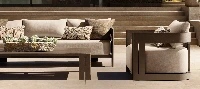
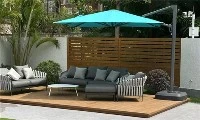
While hotel buyers often pair pool deck sun beds with a modern teak outdoor sectional to build cohesive outdoor lounge zones, understanding how individual loungers handle seasonal storage is vital for minimizing labor costs and protecting long-term capital investments.

🏗️ 1. Engineering Stackability in Commercial Timber Furniture
Standard residential teak loungers are usually built with fixed, wide-arm frames and straight legs that prevent nesting. Stacking them forces timber-on-timber contact, causing gouges, structural strain, and finish damage.
Commercial-grade teak sun loungers overcome these physical constraints through precise structural engineering:
Tapered Frame Geometry: The rear legs and lower side rails are milled at slight inward angles, allowing the upper lounger to nest neatly over the lower unit without jamming.
Integrated Rubber Buffers: Non-marking EPDM rubber bumpers or marine-grade brass wear strips are recessed into the underside of the main frame. These buffers absorb structural weight and prevent direct wood-to-wood scraping during stacking.
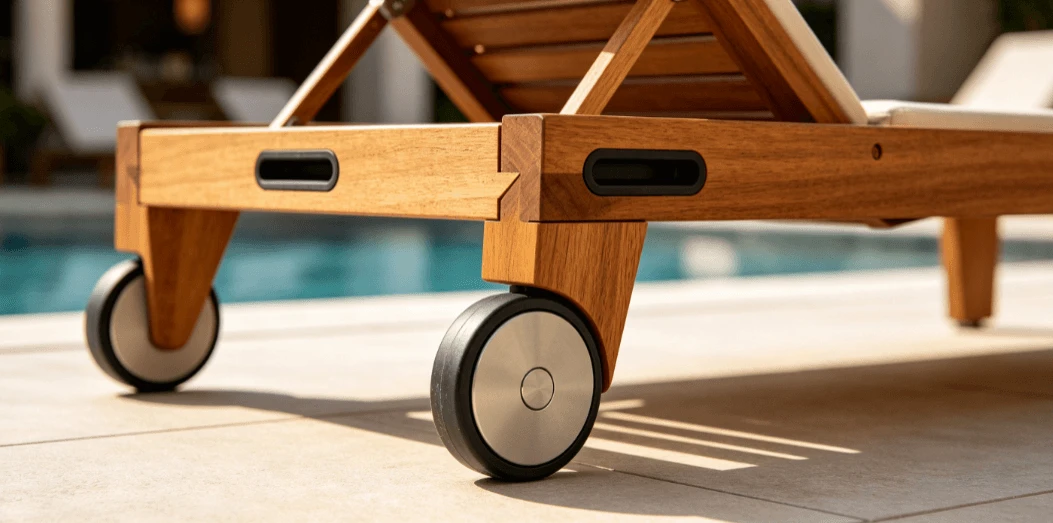
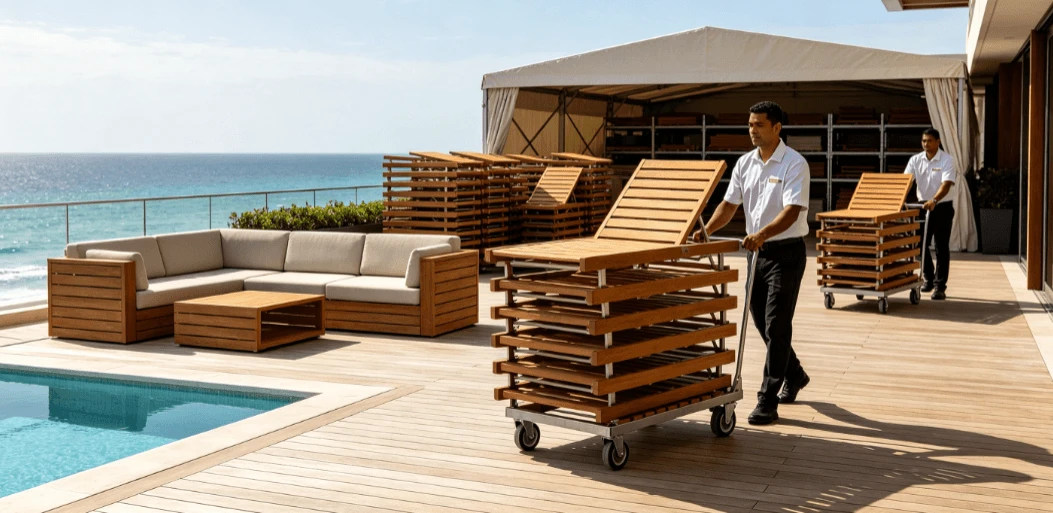
Recessed Rear Wheels: High-grade commercial loungers feature heavy-duty wheels integrated flush into the inner rear legs, allowing staff to roll stacked units effortlessly without lifting full stacks.
Reinforced Stress Joints: Stacking exerts vertical load force on the bottom lounger. Utilizing mortise and tenon joinery secured with teak dowels ensures frames resist racking under multi-unit stacks.When evaluating stackable designs, procurement teams must verify that products pass rigorous physical testing, such as the EN 581 standard for commercial contract furniture safety and durability, as well as factory compliance under ISO 9001 quality management systems.

Commercial Stackable vs. Non-Stackable Teak Loungers Comparison
| Structural & Operational Criteria | 🪵 Commercial Stackable Teak Lounger | 🪑 Non-Stackable Residential Lounger |
| 📐 Nesting Design Geometry | Tapered Leg Profile & Beveled Inner Rails | Straight Box Frame Architecture |
| 🛡️ Surface Protection | Recessed EPDM rubber bumpers | Direct Wood-on-Wood Surface Contact |
| 📦 Maximum Safe Stack Capacity | 4 to 6 Units High | Single Unit Only (Unstackable) |
| 🚚 Mobility & Transit Efficiency | Integrated Rear Wheels for Rolling | Two-Person Manual Carry Required |
| 📐 Storage Footprint (100 Units) | ~200 – 250 Sq. Ft. | ~1,100 – 1,300 Sq. Ft. |
| 🔩 Structural Load Joint Standard | Mortise and tenon joinery | Standard Dowel or Surface Screws |
| 📜 Safety & Quality Compliance | EN 581 standard & ISO 9001 | Basic Residential Standards |

❄️ 2. Off-Season Storage Protocols and Winterization Physics
Knowing whether loungers can physically stack is only half the operational equation. Property managers must also execute correct off-season storage techniques to preserve the timber's integrity during cold, wet, or freezing months.
Grade A teak contains natural rubber resins and a high natural silica content, making its heartwood naturally resistant to moisture penetration and wood-destroying fungi. However, improper storage environments can still compromise hardware or cause surface mold growth.
Breathable Storage vs. Plastic Wrapping
A common mistake made by seasonal maintenance teams is wrapping stackable loungers in non-breathable plastic stretch wrap or low-grade tarps.
Plastic seals ambient moisture inside the stack, creating a micro-greenhouse effect. When temperatures fluctuate, trapped condensation cannot evaporate, causing surface mildew and hardware tarnishing even on premium timber.
Indoor Storage (Ideal): Dry, unheated, well-ventilated storage rooms or warehouse vaults.
Outdoor Covered Storage (Alternative): Stacked under covered verandas or fitted with custom, marine-grade breathable canvas covers featuring mesh air vents.
Ground Clearance: Always elevate stacked loungers at least two inches off damp concrete using composite blocks to prevent moisture wicking into the bottom legs.
Properties sourcing sustainable plantation teak outdoor furniture wholesale gain a major operational advantage: dense plantation heartwood undergoes strict kiln-drying to achieve an equilibrium moisture content between 8% and 12%, ensuring frames stay dimensionally stable throughout freeze-thaw cycles without checking or cracking.
Off-Season Storage Method Performance Comparison
| Storage Method | 💨 Air Circulation | 🛡️ Mold & Mildew Risk | 🧹 Labor Effort | 🌟 Timber Integrity Outcome |
| 🏢 Ventilated Indoor Vault | Optimal Air Flow | Extremely Low | Moderate | Perfect Structural Preservation |
| ☂️ Covered Outdoor Deck + Canvas | Good Circulation | Low Risk | Low Effort | Excellent Weathering Resistance |
| 📦 Sealed Plastic Shrink Wrap | Zero Air Flow | Extremely High (Trapped Moisture) | High Effort | Mold Risk & Hardware Corrosion |
| 🌦️ Exposed Outdoor (Uncovered) | Unrestricted Air Flow | Moderate (Surface Silvering) | Zero Effort | Natural Silvery Patina Formation |
🚚 3. Operational Labor Costs and Storage Footprint Reductions
For large-scale resorts operating 100 to 500 sun loungers across multiple pool decks, seasonal transition speed directly impacts operational budgets.
Non-stackable loungers require vast warehouse floor space, taking up valuable real estate that could otherwise house seasonal equipment or maintenance operations.
Stacking loungers 4 to 6 units high reduces the required storage footprint by up to 80%.When resort operations combine stackable pool loungers with modular teak garden furniture sets on dining patios, the entire property winterization process can be executed in days rather than weeks.
Resort Winterization Operational & Labor Metrics (100 Loungers)
| Operational Metric | 🪵 Stackable Teak System | 🪑 Fixed Frame Teak System | 📈 Operational Impact |
| 📐 Required Storage Footprint | 200 – 250 Sq. Ft. | 1,100 – 1,300 Sq. Ft. | 80% Real Estate Savings |
| ⏱️ Deck Clearance Time (4 Crew) | 4.5 Hours | 16.0 Hours | 71% Labor Cost Reduction |
| 🚚 Transit Mechanics | Roll-and-Transit (Built-in Wheels) | Hand-Carry (2 Staff per Chair) | Reduced Staff Strain & Fatigue |
| 🛡️ Transport Damage Risk | Minimal (Protected Bumpers) | High (Accidental Drops & Scratches) | Lower Annual OpEx Repairs |
| ⚡ Spring Re-deployment Speed | Rapid Setup (Same Day) | Slow Multi-Day Setup | Faster Deck Revenue Generation |
🏡 4. Bridging Commercial Performance to Luxury Residential Patios
While stackability is a core requirement for commercial venues, luxury residential estates increasingly demand the same engineering standards.
Homeowners with private oceanfront villas or expansive sun decks face similar seasonal storage challenges during winter months.
A high-net-worth homeowner investing in a luxury modern outdoor teak sectional sofa for residential patio settings often purchases matching stackable loungers for pool areas. The ability to neatly stack four loungers under a fitted cover during off-season months preserves property aesthetics without requiring massive garage space.
To verify long-term timber origin and environmental responsibility, discerning homeowners and commercial developers alike should look for valid third-party certifications:
FSC Certification: Ensures timber originates from responsibly managed forests that maintain ecological balances.
SVLK Certified: Confirms full Indonesian legal wood traceability from harvest to final export.
TÜV Rheinland Testing: Validates structural stability, weight capacity, and safety compliance under rigorous laboratory conditions.
🧹 5. Step-by-Step Maintenance Protocol Before Stacking
Executing a standardized pre-storage maintenance routine ensures furniture emerges from winter storage ready for immediate deployment.
Cushion Storage Rules
Never stack teak loungers with deep-seating cushions left inside the frames.
Cushions featuring reticulated quick-dry foam and covers made from solution-dyed acrylic fabrics (such as Sunbrella or Agora) should be removed, cleaned, dried, and stored vertically in clean, dry textile storage bags. This prevents foam compression set and keeps timber oils from migrating into cushion fabrics during months of contact.
Checking fasteners to ensure all Grade 316 stainless steel hardware components remain tight prevents frame play when stacked units are rolled into storage.
❓ FAQ
Q1: Can commercial outdoor teak lounge chairs be stacked without scratching the timber finish?
Yes. Commercial-grade stackable teak loungers feature recessed EPDM rubber bumpers or marine-grade wear pads on the underside of the main side rails. These buffers bear the weight of upper loungers and maintain a small air gap, preventing wood-to-wood contact and protecting the natural timber surface from scratches.
Q2: How high can commercial teak sun loungers be safely stacked?
For safety and ergonomic handling, industry guidelines recommend stacking commercial solid teak loungers 4 to 6 units high. Stacking beyond 6 units increases the center of gravity and makes moving stacks more challenging for facility staff.
Q3: Is it safe to leave stacked teak loungers outdoors during freezing winter months?
Yes, provided they are elevated off wet ground and covered with breathable, weather-resistant canvas covers. Grade A teak handles freezing temperatures exceptionally well due to its low moisture content and dense natural oils. However, they should never be tightly wrapped in non-breathable plastic, as trapped condensation causes mold.
Q4: How do staff move heavy stacks of teak loungers efficiently?
Engineered commercial loungers incorporate recessed wheels into the inner rear legs. Staff can tilt a stack of 4 loungers backward onto these integrated wheels and roll the stack across flat concrete or pool decks without needing heavy forklifts or multi-person hand carrying.
Q5: Do stackable teak loungers require special hardware compared to fixed loungers?
Yes. Stackable loungers endure higher vertical load concentrations. They utilize heavy-duty mortise and tenon joinery and corrosion-proof Grade 316 stainless steel bolts and brackets to resist frame racking during repeated stacking and transit.
Q6: Can cushions be left on teak loungers when they are stacked for the season?
No. Cushions should always be removed prior to stacking. Stacking loungers onto cushions compresses the foam core over long periods and traps wood oils against the fabric. Store cushions separately in clean, dry, ventilated storage bags.
Q7: What wood certification should commercial buyers request for wholesale teak orders?
Procurement managers should verify FSC certification for sustainable forest management, SVLK certified documentation for legal timber origin compliance, and independent laboratory safety testing such as TÜV Rheinland testing or the EN 581 standard.
Q8: How much storage space can a resort save by switching to stackable teak loungers?
Switching from fixed-frame loungers to stackable models reduces storage floor space requirements by up to 80%. A property storing 100 stackable loungers needs roughly 200 to 250 square feet of floor space, compared to over 1,100 square feet for unstackable alternatives.
Q9: Does constant stacking cause the natural oils in teak wood to leak onto lower frames?
In Grade A kiln-dried teak, natural oils remain bound deep within the wood fibers and will not bleed or leak onto adjacent frames under normal seasonal storage temperatures. Basic rubber bumper pads prevent direct surface contact entirely.