
Oceanfront luxury resorts, coastal hotel dining terraces, and seaside residential developments present some of the most aggressive corrosive environments on earth. Specifying high-performance aluminum outdoor furniture and poolside sun loungers for these high-salinity locations requires an uncompromising understanding of chemical degradation, protective coating physics, and standardized laboratory verification. Commercial procurement directors and project specifiers frequently face a critical technical metric: how many hours of salt spray testing (ASTM B117) should outdoor metal furniture pass for oceanfront properties?

To prevent premature surface blistering, metal degradation, and structural pitting, outdoor metal furniture installed within 1,000 feet of an ocean shoreline must pass a minimum threshold of 3,000 to 4,000 hours of ASTM B117 neutral salt spray fog testing. For properties situated in moderate coastal zones (between 1,000 feet and 3 miles from the coast), a benchmark of 1,500 to 2,000 testing hours is highly recommended. Partnering with an experienced custom outdoor furniture manufacturer like Howvin enables commercial developers to integrate specialized architectural structures-such as a heavy-duty poolside pergola with shade-engineered specifically to exceed these stringent lab benchmarks.
Multi-Variable Environmental Mechanics Driving Coastal Metal Breakdown
Understanding why coastal environments destroy standard metal furniture requires examining the simultaneous chemical and mechanical stress factors at play:
Chloride Aerosol Accumulation and Electrolyte Formation: Marine winds carry micro-droplets of ocean water containing high concentrations of sodium chloride. When deposited onto metallic surfaces in coastal microclimates where relative humidity routinely exceeds 65%, these hygroscopic salt crystals absorb atmospheric moisture, forming a continuous, highly conductive corrosive film. Active chloride ions break down weak surface oxide layers, triggering aggressive localized pitting corrosion.
Photolytic Polymer Breakdown and UV Degradation: Intense ultraviolet radiation (UV-A and UV-B) continuously attacks the organic polymer binders in low-tier powder coatings. Photolytic degradation causes surface chalking, gloss loss, and micro-cracking. As film elasticity degrades, daily thermal expansion cycles create micro-fissures, establishing open pathways for airborne salt moisture to reach the underlying substrate.
Sub-Surface Filiform Corrosion Propagation: When moisture and aggressive chloride ions enter microscopic coating defects or unsealed cut edges, a subterranean oxidation cell forms. This results in filiform corrosion, which spreads in worm-like threads beneath the paint film, lifting the protective layer and causing catastrophic surface blistering.
Galvanic Coupling at Structural Joints: Joining dissimilar metals-such as using standard carbon steel or basic 304-grade stainless fasteners inside structural aluminum frames-creates a high-risk galvanic couple. In the presence of conductive salt mist, the aluminum acts as a sacrificial anode, suffering rapid galvanic corrosion around structural welds, hinges, and fastener points.

Standardized Accelerated Testing Benchmarks and Architectural Equivalencies
[🔬 Laboratory Testing Protocols] To evaluate material survival rates under controlled conditions, industry specifiers rely on accelerated environmental testing protocols established by ASTM International. The baseline benchmark across North America is the ASTM B117 standard practice for operating salt spray fog apparatus.
Laboratory Testing Conditions vs. Coastal Field Survival
Inside an ASTM B117 test chamber, specimens are continuously exposed to a atomized 5% sodium chloride fog maintained at a constant internal temperature of 35°C (95°F) with a tightly controlled pH range between 6.5 and 7.2. While salt spray testing provides an accelerated relative ranking of coating integrity, lab exposure hours do not map in a single rigid linear equation to real-world days. However, extensive field history establishes clear performance tiers across international architectural standards:
240 to 500 Hours: Represents basic indoor or protected industrial surface finishes. Furniture with this rating will show visible paint failure and surface blistering within months on an open beachfront terrace.
1,500 Hours: Aligns with entry-level architectural specifications such as AAMA 2603 set by the Fenestration and Glazing Industry Alliance (FGIA) or the baseline European Qualicoat Seaside standard managed by the Qualicoat Association. Suitable for inland urban commercial installations located more than 3 miles from ocean coastlines.
3,000 Hours: Meets the high-performance AAMA 2604 architectural specification. Mandatory for commercial outdoor furniture placed in moderate coastal zones with indirect marine exposure.
4,000+ Hours: Satisfies the ultimate superior-performance AAMA 2605 specification. Finishes achieving this standard demonstrate the extreme chemical resistance needed for direct beachfront and oceanfront installations.
For international projects, testing protocols are frequently cross-referenced with standards maintained by the International Organization for Standardization (ISO), specifically ISO 9227 for artificial salt fog exposure and ISO 12944 for marine corrosion categories (specifically Class C5-M for extreme coastal environments).
Architectural Surface Coating Standards Comparison
| Architectural Standard / Certification | Governing Body | Salt Spray Test Duration (ASTM B117 / ISO 9227) | Outdoor Real-World Weathering Requirement | Surface Finish & Resin Technology | Recommended Coastal Distance |
|
AAMA 2603 [cite: 6, 11] |
FGIA [cite: 3, 6] |
1,500 Hours |
1 Year South Florida Exposure (Basic color retention) |
Standard Cross-Linked Polyester Powder |
Inland / Sheltered Interior (>3 Miles) |
|
AAMA 2604 [cite: 6, 11] |
FGIA [cite: 3, 6] |
3,000 Hours |
5 Years South Florida Exposure (High UV & chalk defense) |
Super-Durable Polyester Powder System |
Moderate Coastal (1,000 ft to 3 Miles) |
|
AAMA 2605 [cite: 5, 6, 7, 11] |
FGIA [cite: 3, 6] |
4,000 Hours |
10 Years South Florida Exposure (Maximum gloss & color retention) |
Advanced fluoropolymer FEVE coating [cite: 6] |
Direct Oceanfront / Beachfront (<1,000 ft) |
|
Qualicoat Seaside [cite: 5] |
Qualicoat Association [cite: 3, 5] |
1,500 Hours (Includes mandatory Acetic Acid AASS phase) |
2 Years European Florida-equivalent exposure |
Architectural Powder over Chemical Etched Substrate |
Standard Marine / Waterfront Terraces |
|
ISO 12944 C5-M [cite: 4] |
ISO [cite: 3, 4] |
1,440+ Hours (Cyclic marine fog atmosphere) |
Multi-year field verification in active marine zones | Multi-Layer Marine Epoxy & Topcoat System |
Extreme Marine & Offshore Installations |

Substrate Metallurgy, Pretreatment Engineering, and Hardware Isolation
[🛡️ Material Science Specifications] Achieving 4,000 hours of salt spray resistance requires seamless engineering across the entire metal-treatment assembly, from raw alloy selection to final hardware assembly.
Substrate Processing and Conversion Layers
Aluminum is the ideal base metal for commercial coastal furniture due to its natural passivation properties. However, raw commercial aluminum alloys containing high copper or iron contaminants remain susceptible to deep pitting if left untreated.
Commercial structural frames constructed from 6000-series extruded aluminum must undergo a comprehensive multi-stage surface preparation sequence:
Chemical Cleaning and Etching: Metal surfaces undergo alkaline degreasing followed by acid etching to remove shop oils, natural non-uniform oxides, and surface impurities, creating a micro-textured profile.
Pretreatment Application: The etched metal is treated with a non-chromate zirconium conversion coating. This microscopic layer creates a chemical bond with the raw metal, sealing microscopic pores and preventing sub-surface oxidation from expanding if the outer paint layer suffers physical scratches.
Advanced Coating Application:
Thermoset Powder Coating: Applied electrostatically and thermally cured to form a dense, protective cross-linked film. High-grade thermoset systems provide excellent impact resistance and meet AAMA 2604 requirements.
Fluoropolymer FEVE Finish: Advanced liquid or powder coatings based on fluoroethylene vinyl ether resins. FEVE chemistry provides superior carbon-fluorine bond strength, delivering AAMA 2605 compliance, 4,000+ hours of salt spray defense, and unmatched chalk resistance.
Hardware Metallurgy and Galvanic Isolation
Hardware choices frequently determine the operational lifespan of coastal furniture. Standard 304-grade stainless steel lacks sufficient molybdenum, causing it to develop unsightly brown tea-staining when exposed to ocean air. Commercial coastal specifications must strictly mandate passivated 316 stainless steel fasteners. Additionally, non-conductive neoprene or nylon isolation washers must be installed between stainless steel fasteners and aluminum structural components to interrupt electrical pathways and prevent localized galvanic degradation.

Substrate and Coating System Performance Comparison Matrix
| Base Substrate Material | Pretreatment Process | Surface Coating System | ASTM B117 Lab Performance | Real-World Service Expectation | Maintenance & Operational Profile |
| Standard Cast Aluminum Alloy | Basic Solvent Degrease | Standard Commercial Polyester |
500 – 1,000 Hours |
1 to 3 Years (High risk of pitting) |
Intensive monthly scrubbing; frequent paint touch-ups |
|
Anodized Aluminum (Class I) [cite: 3, 7] |
Electro-Chemical Anodic Bath |
Integrated anodized aluminum oxide film |
3,000 Hours |
3 to 5 Years (Prone to surface chalking) |
Mandatory bi-weekly freshwater rinsing |
|
Structural Extruded Aluminum [cite: 7] |
Zirconium Conversion Pretreatment |
Super-Durable Thermoset Powder Coating [cite: 3, 5] |
3,000 Hours (AAMA 2604) |
7 to 10+ Years (Sustained structural integrity) |
Quarterly low-pressure freshwater washdown |
|
Marine-Grade Extruded Aluminum [cite: 4, 7] |
Multi-Stage Conversion Pretreatment |
Premium Fluoropolymer FEVE Coating [cite: 6] |
4,000+ Hours (AAMA 2605) |
15+ Years (Maximum corrosion & UV protection) |
Semi-annual rinse; minimal operational oversight |
|
316 Stainless Steel Components [cite: 4] |
Chemical Passivation Bath | Raw Mechanical Polished Finish |
3,000+ Hours |
10 to 15 Years (Excellent structural hold) | Periodic polish to remove ambient salt deposits |
Commercial ROI Analysis: Capital Expenditure vs. Long-Term Asset Yield
[📊 Financial Life-Cycle Modeling] For commercial developers, procurement decisions balanced purely on initial purchase price often create severe long-term operational liabilities. Evaluating long-term financial returns requires evaluating both upfront capital expenditure (CapEx) and long-term operating expenses (OpEx).
Life-Cycle Cost Drivers in Coastal Commercial Environments
Asset Replacement Cycles: Outdoor furniture built to low commercial standards (500–1,000 salt spray hours) often exhibits visible frame corrosion, paint peeling, and structural failure within 24 to 36 months of direct coastal exposure. Over a 10-year facility operating timeline, a coastal resort using low-grade furniture will undergo three full asset replacement cycles. Specifying AAMA 2604 or 2605-compliant furniture ensures the asset survives the entire 10-year operating period intact.
Maintenance Labor Overhead: Low-grade surface finishes require continuous labor-intensive maintenance-including bi-weekly salt scrubbing, paint touch-ups, and localized rust mitigation-to slow down degradation. High-performance coatings require only periodic freshwater rinses, drastically lowering ongoing facility labor costs.
Property Positioning and Revenue Impact: Visible rust stains, flaking paint, and degraded seating negatively affect guest satisfaction metrics and online venue reviews. Maintaining pristine outdoor spaces directly supports premium room rates and event venue pricing.
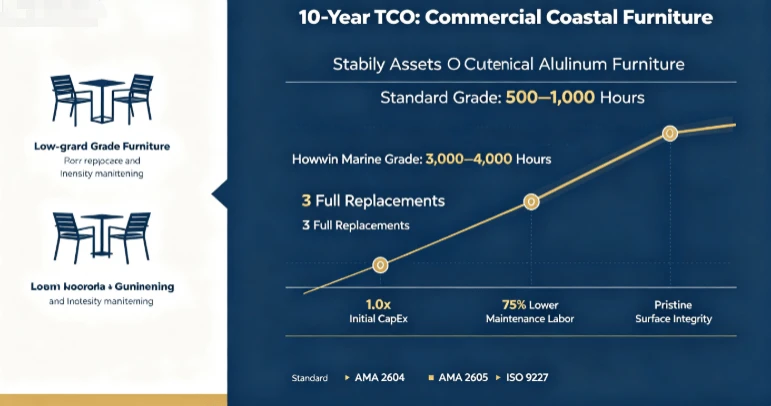
10-Year Commercial Life-Cycle Financial Comparison Matrix
Note: The following life-cycle cost model projects performance for a 100-unit commercial lounge and seating asset deployment at a oceanfront resort over a 10-year operational horizon.
| Life-Cycle Financial & Operational Parameter | Standard Commercial Grade (500–1,000 Salt Spray Hours) | Howvin Architectural Marine Grade (3,000–4,000 Salt Spray Hours) | Net Operational & Financial Advantage |
| Initial Asset Procurement CapEx | Baseline Initial Procurement | ~35% Higher Initial Asset Investment |
Upfront premium offset by extended asset service life |
| Expected Structural Lifespan |
3 Years (Requires complete replacement) |
10+ Years (Sustains structural integrity) |
Eliminates two full re-procurement capital expenditures |
| 10-Year Cumulative Replacement Factor |
3.0x Initial Procurement Outlay |
1.0x Initial Procurement Outlay |
Direct 60% reduction in total 10-year capital expenditure |
| Required Maintenance Schedule |
Bi-Weekly intensive manual scrubbing |
Quarterly fresh water rinse |
Reduces annual maintenance labor hours by over 75% |
| 5-Year Surface Integrity Integrity |
High risk of chalking, peeling, and rust stains |
Near-zero surface degradation; high gloss retention |
Protects property visual standards and brand value |
| Net Total Cost of Ownership (TCO) |
Unfavorable (High ongoing replacement and labor costs) |
Highly Efficient (Optimized long-term asset yield) |
Delivers significantly lower net cost per asset operational year |
FAQ:
What is the technical difference between ASTM B117 and ISO 9227 testing standards for outdoor furniture?
ASTM B117 is the primary North American standard for operating neutral salt spray fog chambers, utilizing a continuous 5% sodium chloride fog at 35°C. ISO 9227 is the international equivalent widely specified across Europe and Asia. While ISO 9227 includes neutral salt spray (NSS) parameters matching ASTM B117, it also defines Acetic Acid (AASS) and Copper-Accelerated Acetic Acid (CASS) protocols designed for specialized coating evaluations.
Does passing 3,000 hours of ASTM B117 testing guarantee complete protection against coastal UV fading?
No. The ASTM B117 protocol measures resistance to corrosion, moisture, and chloride penetration, but does not evaluate UV degradation or color fading. Complete coastal protection requires specifying finishes that pass both ASTM B117 salt spray testing and South Florida outdoor exposure testing under AAMA 2604 or AAMA 2605 standards to guarantee long-term color and gloss retention.
Why is 316-grade stainless steel hardware specified over 304-grade for oceanfront outdoor furniture?
Grade 316 stainless steel contains 2% to 3% molybdenum, an alloying element missing from Grade 304. Molybdenum significantly increases resistance to chloride pitting and crevice corrosion in marine environments. While 304 stainless steel quickly develops unsightly cosmetic tea-staining in salt air, passivated 316 stainless steel retains its visual and structural integrity.
How does thermoset powder-coated aluminum compare to anodized aluminum for oceanfront poolside sun loungers?
Thermoset powder coatings compliant with AAMA 2604 or AAMA 2605 deliver a thick, flexible protective envelope (60–110 microns) that accommodates frame flexing and thermal movement without cracking. Anodizing creates a thin, hard aluminum oxide layer (18–25 microns). While anodizing provides surface hardness, it offers limited color versatility and is prone to surface chalking and pitting in coastal air if salt deposits are not washed off frequently.
What maintenance routine is required to maintain manufacturer warranties on oceanfront outdoor furniture?
Even high-performance finishes meeting AAMA 2605 and 4,000-hour ASTM B117 standards require periodic cleaning. Manufacturers typically mandate quarterly freshwater washdowns using low-pressure clean water and mild soap to rinse away accumulated salt crystals that trap moisture against the finish.
Can custom frame colors achieve 4,000-hour ASTM B117 corrosion resistance?
Yes, provided the custom finishes are formulated using certified fluoropolymer FEVE or super-durable polyester resin systems sourced from accredited coating suppliers. Custom commercial manufacturers work with certified powder formulators to deliver bespoke colors, matte textures, and metallic effects that fully satisfy AAMA 2605 and ASTM B117 performance requirements.