

International ocean freight is no longer just a logistical afterthought. It is a margin killer. For global hospitality buyers and commercial sourcing managers, dead space inside a shipping container is money thrown into the sea. When importing oversized outdoor structures, the math is simple: ocean liners charge by the cube, not by your design intent.
If you partner with a premier pergola manufacturer or an elite UV-resistant patio furniture supplier, you quickly realize that engineering does not stop at the product frame. It extends directly into the shipping box. To optimize shipping volume for aluminum gazebo shipments, structural engineers must bridge the gap between architectural stability and CBM reduction.
Whether you are managing a massive hotel pergola installation or running a high-volume Hotel patio furniture wholesale distribution network, mastering the physics of container utilization rate and modular knock-down architecture is your ultimate competitive advantage.

🛠️ 1. Structural Engineering: Welded Rigidity vs. Modular KD Design
Oversized posts and massive overhead louvers are the hallmarks of a premium hotel pergola. However, shipping a fully welded, monolithic 6-meter aluminum pillar is economic suicide. It creates irreversible volumetric void spaces inside the container.
The fix? Advanced modular knock-down architecture. By utilizing internal interlocking steel inserts and precision-machined connection brackets, heavy-duty 6063-T5 aluminum alloy extrusions can be split into strategic sub-components without sacrificing wind-load capacities.
📦 Structural Design Impact on Shipping Economics
| Engineering Factor | Monolithic Welded Structures | Modular Knock-Down (KD) Design |
| Volumetric Efficiency | High void ratios, low nesting capability | Maximum nesting, minimal air space |
| Average CBM per Unit | 4.2 – 5.8 CBM | 1.1 – 1.6 CBM |
| Container Fitment | Frequent forklift damage, rigid positioning | Linear stacking, optimized for 40HQ height |
| Structural Integrity | Native rigid strength | Equivalent strength via heavy-duty inner sleeves |
| On-Site Assembly Time | Low (plug and play) | Medium (requires mechanical fastening) |
📐 2. Packaging Architecture: Eliminating Transit Friction
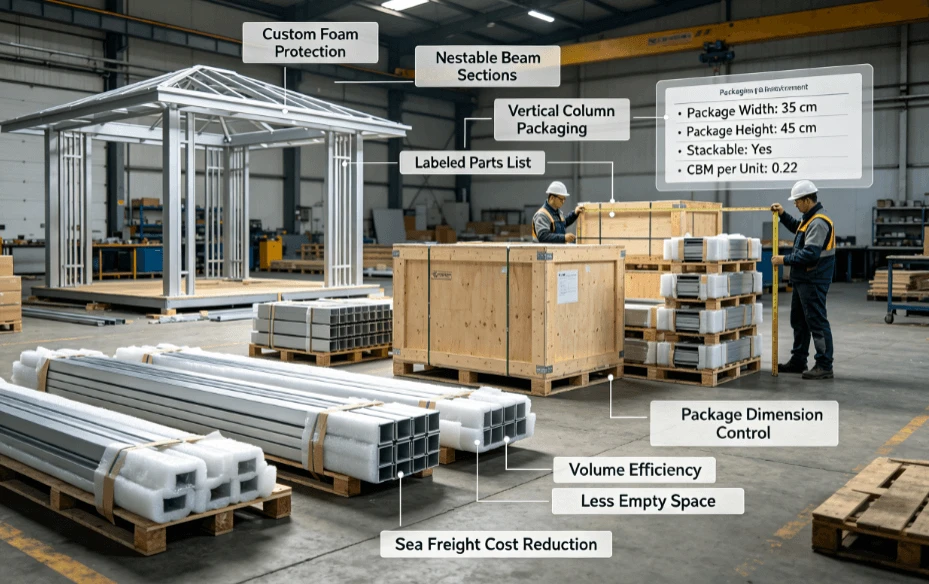
Standard bubble wrap is a liability when dealing with heavy, sharp-edged extruded aluminum profiles. During high-seas transit, container vibration causes structural friction, leading to surface micro-scratches that ruin premium powder coatings.
To prevent this, factory packaging must evolve from basic wrapping to advanced multi-layer cushioning. Heavy-gauge EPE foam sheeting must shield all visible surfaces, while heavy-duty honeycomb paperboard contours the outer perimeter to absorb directional impacts.
📐 Packaging Material Performance & CBM Overhead
| Material Profile | Protective Rating | Thickness Impact | Volumetric Overhead (per 40HQ) |
| Standard Bubble Wrap | Poor (Punctures under heavy load) | 5mm | Minimal (+2% CBM) |
| EPE Foam + Honeycomb Board | Excellent (High impact resistance) | 15mm – 20mm | Managed (+5% CBM) |
| Wooden Crating (Non-Optimized) | Superb (Crush-proof) | 50mm+ | Disastrous (+25% CBM) |
| ISPM-15 Certified Skids | High (Forklift ready) | Variable | Optimized for base loading |
🚢 3. Container Loading Matrix: 20GP vs. 40HQ Utilization
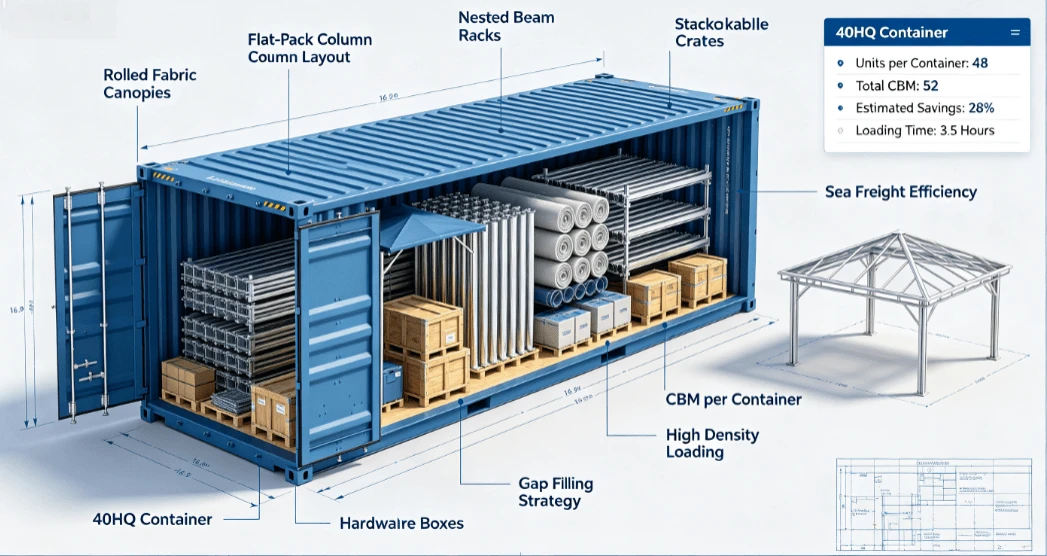
Oversized aluminum posts present a unique geometric challenge: they easily exceed the internal length limits of standard 20FT containers or leave massive unutilizable space at the ceiling line. Nested loading-where smaller components like louvers, gutters, and hardware boxes are strategically tucked inside the hollow perimeter of the main perimeter beams-is mandatory.
🚢 Container Utilization Dynamics for Optimized Gazebos
| Logistics Metric | 20GP Container (Standard Load) | 40HQ Container (Nested KD Load) |
| Max Linear Length Limit | ~5,898 mm | ~12,032 mm |
| Volumetric Capacity Limit | ~33 CBM | ~76 CBM |
| Unoptimized Post Yield | Approx. 6–8 full systems | Approx. 18–22 full systems |
| Optimized Nested Yield | Approx. 14–16 full systems | Approx. 45–52 full systems |
| Freight Cost per Unit | High (Sub-optimal cube utilization) | Lowest (Maximum payload saturation) |
📜 4. Global Compliance, Structural Validation & Certification
Reducing packaging volume must never compromise structural safety. International commercial projects demand rigorous verification from independent, third-party testing giants.
Before any modular gazebo system is loaded into an ocean container, the structural joints, metal composition, and surface coatings must carry recognized industrial stamps:
TUV Rheinland: Validates the mechanical loading capacity and structural safety profiles of the interlocking connector sleeves.
SGS wind-load verification: Proves that the modular, split-post design can successfully withstand hurricane-force wind thresholds without catastrophic deflection.
Qualicoat Class 2: Ensures that the architectural-grade exterior powder coating survives the brutal, salt-spray environments of oceanic transit and coastal installations.
CE compliance: Guarantees that all automated motorized louver systems integrated into the gazebo meet strict European safety and electrical operational benchmarks.
❓ FAQ:
📦 Q1: Does shifting to a modular KD design compromise the wind-load rating of the gazebo?
A: Not if engineered correctly. By using heavy-gauge inner steel sleeves or reinforced aluminum structural couplings at the stress points, a modular frame matches the shear strength of a welded system. All configurations must undergo rigorous SGS wind-load verification to ensure real-world stability.
📐 Q2: Why is wooden crating discouraged for high-volume commercial ocean freight?
A: Traditional wooden crates add significant wall thickness (often up to 50mm per side), which drastically balloons the total CBM. Furthermore, raw wood requires mandatory ISPM-15 fumigation protocols, increasing lead times and port clearance costs. Precision-cut honeycomb paperboard offers identical crush protection with a fraction of the volumetric footprint.
🛠️ Q3: What is "nested loading" and how does it drive down international shipping costs?
A: Nested loading is the spatial art of packing smaller components (like motorized louvers, LED drivers, and mounting brackets) inside the structural cavities or void zones created by the large perimeter beams. This eliminates "empty air" inside the carton, maximizing your container utilization rate.
🚢 Q4: Can a 6-meter aluminum gazebo post fit inside a standard 20GP container?
A: No. The absolute maximum internal length of a standard 20GP container is approximately 5,898 mm. Attempting to ship a 6-meter monolithic post requires a 40FT container, which creates immense dead space if you aren't ordering in bulk. A modular, split-post design allows you to seamlessly leverage 20GP shipping routes.
💡 Q5: How do you prevent surface friction and finish degradation during a 45-day ocean voyage?
A: We utilize custom-extruded EPE foam sheeting with a minimum thickness of 15mm, supplemented by inter-layer plastic films. This prevents the metal surfaces from rubbing against each other when the shipping container experiences low-frequency hull vibrations on the water.
📜 Q6: What architectural coatings should commercial buyers look for to resist marine corrosion?
A: Demand Qualicoat Class 2 or premium PVDF finishes. These heavy-duty architectural coatings are explicitly formulated to resist the corrosive effects of salt air, UV degradation, and high humidity common to international ocean transit and oceanfront hospitality layouts.