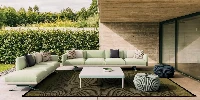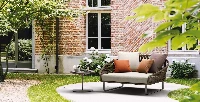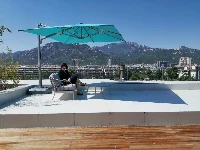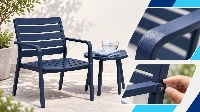

A courtyard terrace can look calm at noon and become a very different asset after closing time. Chairs are moved, tables are grouped, umbrellas are taken down, cleaning crews arrive, and anything left close to a public edge becomes easier to remove. That is why a hotel outdoor furniture supplier should not treat anti-theft hardware as a small accessory added after the furniture has already been specified.
A sidewalk café has an even harder balancing act. The furniture must remain attractive enough for customers to choose the outdoor seats, light enough for staff to handle, and controlled enough to discourage opportunistic removal. A good restaurant outdoor furniture supplier therefore needs to think beyond the lock itself and consider the whole furniture-to-floor relationship.

The situation changes again when a commercial pergola for outdoor dining is part of the project. Columns, drainage, access routes, lighting, and furniture anchors may compete for the same pieces of floor area, so the best anchoring strategy is usually decided during layout planning rather than after installation.
Even the most ordinary-looking metal outdoor dining table and chairs can behave very differently depending on the floor substrate, coastal exposure, coating system, fasteners, and closing routine. The safest buying decision is not "Which lock is strongest?" It is "Which security method fits this exact site without creating new maintenance or operational problems?"
1.Quick Answer: What Is the Best System for Commercial Outdoor Café Furniture?

There is no single anti-theft system that is automatically best for every terrace.
For a private courtyard on a suitable structural concrete slab, a discreet permanent anchor can offer strong resistance to unauthorized removal. For a sidewalk café where staff need to move furniture every day, a security cable, grouped locking system, or removable tether may be more practical. Where drilling into the paving is prohibited, an engineered ballasted solution can provide additional resistance without permanently penetrating the surface.
The important distinction is between security of the furniture and strength of the connection to the site.
A premium lock attached to a weak furniture leg does not create a secure asset. A strong fastener installed into a weak topping layer does not create a reliable floor anchor. And a heavy table that is difficult to move is not automatically protected against theft.
A practical site-first view
🔒 Theft exposure - How easy would it be for one person to remove the furniture?
⚓ Substrate quality - What is actually beneath the visible paving?
🌧️ Environmental exposure - Will moisture, salt, UV, pollutants, or cleaning chemicals attack the system?
🚶 Daily handling - Does the team need to move, stack, wash, store, or reconfigure the furniture?
💰 Lifecycle value - Will the security hardware reduce asset loss without creating excessive labor or repair costs?
This is the foundation for selecting anti-theft and floor-anchoring systems in commercial settings.
2.Why the Lock Is Only One Part of the Security System

A café owner usually notices the lock first. A project manager notices what surrounds it.
Imagine a terrace with thirty chairs and eight tables. The furniture is attractive and relatively light. During the day, staff move everything several times. At closing, they have only a limited amount of time to secure the terrace.
If every chair needs to be unlocked individually, employees eventually stop following the procedure. The security system may be technically strong and practically ignored.
Now change the situation. The eight tables are fixed in defined positions. Chairs are grouped, stored, or tethered through a controlled system. The staff can secure the entire terrace in one repeatable routine.
The second system may use less visible hardware while producing a better real-world security outcome.
That is why commercial outdoor furniture security should be designed around behavior, not just hardware.
3.The Main Types of Anti-Theft and Floor-Anchoring Systems

Bolt-Down Plates
A mechanical anchor connects a dedicated furniture fixing point to the structural floor. This is normally the most appropriate direction when furniture is intended to remain in a defined position for long periods and drilling is permitted.
The important part is the phrase "structural floor."
A decorative tile surface, thin topping, or loose paver is not automatically the layer that should receive the load. The installer needs to understand the actual substrate, edge conditions, concealed services, waterproofing, and project constraints before finalizing the fixing method.
This approach works particularly well for selected high-value tables, fixed benches, large hospitality assets, or furniture positioned in controlled courtyards.
Security Cables and Tethers
A security cable provides a more flexible alternative when staff still need to reposition furniture.
For sidewalk cafés, this can be useful because a chair or table can remain movable during service while still being connected to a controlled fixing point after closing.
The cable should not be oversold as an absolute theft-proof solution. Its purpose is generally to increase resistance, discourage casual removal, and slow down unauthorized handling.
The detail that often matters most is routing.
A security cable crossing a pedestrian path may solve one problem while creating another.
Grouped Furniture Security
Sometimes the smartest move is not securing every chair independently.
Tables can act as fixed reference points, while chairs can be linked in manageable groups. This reduces the number of independent pieces that can be casually removed and makes closing procedures easier for staff.
Grouped systems can also work well for event-driven venues, where operators need to change furniture configurations without completely removing the security infrastructure.
The trade-off is visual. More visible connections can make a premium terrace look overly industrial, so the hardware needs to be placed where customers and staff are least likely to notice it.
Ballasted Bases
Where drilling is restricted, ballasted bases can add security through controlled weight and footprint.
This approach may suit leased premises, heritage paving, temporary terraces, and some public-facing locations where permanent floor penetration requires additional approval.
There is a catch.
Every additional kilogram of ballast becomes part of the operating burden. Staff still need to clean under the furniture, move it for events, protect it during severe weather, and sometimes transport it to storage.
A heavy solution may be difficult to steal and equally difficult to operate.
Recessed and Quick-Release Anchors
A low-profile recessed fixing point can offer an attractive compromise for projects where furniture positions are known early.
During business hours, the connection can remain visually discreet. After closing, furniture can be attached to prepared anchor locations.
This method is most effective when the furniture supplier and site contractor coordinate before paving and waterproofing are finalized. Retrofitting it later is often possible, but the cost and disruption can be much higher.
Which Security Method Fits the Site?
| Security approach | Theft deterrence | Daily mobility | Appearance | Floor drilling | Best fit |
|---|---|---|---|---|---|
| Permanent bolt-down | High | Low | Excellent | Usually required | Fixed courtyard furniture |
| Recessed anchor point | High | Medium | Excellent | Usually required | Planned hospitality project |
| Security cable | Medium | High | Good | Limited or variable | Sidewalk café seating |
| Grouped locking system | Medium–High | Medium | Good | Variable | Reconfigurable terrace |
| Ballasted base | Medium | Low–Medium | Moderate | No | No-drill locations |
| Storage-focused strategy | Depends on site controls | Very high | Excellent during service | No | Seasonal or low-risk areas |
The ranking is intentionally qualitative. Security performance depends on the complete assembly, the theft environment, the fixing point, and the closing procedure.
4.How a hotel outdoor furniture supplier Should Specify Courtyard Anchoring

Hotels are unusual because their terraces rarely serve only one purpose.
Breakfast may require closely spaced dining tables. Afternoon service may use lounge seating. An evening event can require an almost completely different configuration. A wedding team may move furniture again before the regular staff arrive the next morning.
For that reason, a hotel project should usually divide furniture into security zones.
Zone A: Fixed assets
These may include benches, selected dining tables, heavy side tables, or other pieces that rarely change position.
Permanent anchoring makes more sense here.
Zone B: Controlled-mobility assets
Dining chairs, lounge chairs, and movable occasional tables usually need a faster closing routine.
These may benefit from grouped security, removable tethers, or designated storage.
Zone C: Seasonal or event assets
Some furniture simply should not be anchored to the floor.
If an item is routinely moved indoors, stored during storms, or rearranged for large functions, a good storage plan may create more value than permanent anchoring.
This classification is simple, but it can save a project from a common mistake: spending the maximum security budget on every item regardless of how the furniture is actually used.
5.How a restaurant outdoor furniture supplier Should Plan Sidewalk Security

A public sidewalk creates a more complicated environment because the furniture shares space with people who are not part of the restaurant operation.
That introduces:
pedestrians;
bicycles;
strollers;
wheelchairs and mobility devices;
cleaning equipment;
delivery carts;
weather exposure;
public access;
local permitting restrictions.
In the United States, the ADA Standards require accessible routes to serve restaurant dining areas, including outdoor dining areas. Furniture placement, security cables, bases, and anchors therefore need to be reviewed as part of the circulation path rather than treated as separate objects.
That does not mean every sidewalk café has the same layout requirement. Local regulations, site conditions, and the exact facility determine the final arrangement.
The practical lesson is much simpler:
Never design the security system first and the pedestrian route second.
6.Why the Floor Substrate Can Be More Important Than the Anchor

This is where many furniture specifications become too simplistic.
A terrace that looks like stone may actually consist of stone over a mortar bed, a paver system above a slab, a topping layer over waterproofing, or another assembly. The visible surface tells you very little about the holding capacity available to the anchor.
A floor investigation should therefore ask:
What is the structural substrate?
How thick is the usable layer?
Is there waterproofing beneath?
Are there expansion joints?
Are reinforcement bars or services nearby?
Is the surface intended to be drilled?
Can the installation be reversed without major repair?
For rooftop terraces, the issue becomes even more sensitive because waterproofing damage can create a much more expensive problem than replacing a stolen chair.
Substrate Review Matrix
| Floor condition | Main risk | Better procurement response |
|---|---|---|
| Structural concrete | Incorrect anchor selection or placement | Confirm substrate and approved fixing method |
| Pavers over slab | Fixing only into the paving layer | Verify connection to structural support |
| Tile over concrete | Tile cracking and poor edge detailing | Coordinate fixing location and installation method |
| Waterproofed terrace | Membrane damage | Obtain approval before penetration |
| Thin topping layer | Insufficient support | Confirm the structure underneath |
| Unknown floor build-up | Hidden services or weak layers | Conduct site investigation before installation |
| Temporary public surface | Permission and restoration | Consider non-penetrating security |
One of the strongest questions a project buyer can ask is:
"What exactly are you assuming is underneath the furniture anchor?"
A responsible supplier should be able to answer that question without guessing.
7.How Outdoor Conditions Attack Furniture Security Hardware

The outdoor environment rarely damages a product in one dramatic event. More often, several small stresses accumulate.
Rain gets into a joint. Salt dries on a fastener. Cleaning chemicals reach a coating edge. Sun heats the frame. The terrace is washed again. Dust accumulates. The lock is opened and closed hundreds of times.
Eventually the weakest interface starts to show.
Coastal Areas: Salt, Moisture and Dissimilar Metals
Near the coast, corrosion protection needs to be considered as a system.
Stainless steel can provide useful corrosion resistance for fasteners and exposed hardware, but the exact grade should match the environment. In severe chloride exposure, more corrosion-resistant stainless grades may be considered.
Galvanic corrosion is another concern. When dissimilar metals are connected in the presence of moisture, the combination can create a corrosion risk that would not appear when each material is considered separately.
This is why the following details matter:
compatible fasteners;
electrical isolation where appropriate;
coating continuity;
water drainage;
protected connection points;
routine inspection.
A "marine-grade" label without supporting material and hardware information is not a complete specification.
Full Sun and UV Exposure
Outdoor seating can spend hundreds of hours under direct sunlight, particularly on open terraces and rooftops.
UV exposure can affect:
coatings;
plastics;
synthetic fibers;
textiles;
adhesives;
color stability.
ASTM G154 is used for controlled fluorescent UV exposure of materials and products. ISO 4892-3 provides laboratory exposure methods for plastics using fluorescent UV radiation together with heat and water. Neither standard should be interpreted as a universal promise of outdoor service life.
That distinction is important when comparing suppliers.
A test can tell you how a material behaved under a defined test program. It does not magically transform laboratory exposure into a guaranteed number of years in Miami, Dubai, Los Angeles, or a coastal resort.
Humidity and Standing Water
Moisture becomes more damaging when the furniture gives it somewhere to stay.
Look at:
frame cavities, weld transitions, leg ends, feet, base plates, fastener recesses, and fabric seams.
Drainage is often more valuable than adding another layer of marketing language around "water resistant."
Security hardware needs the same attention. A lock that constantly collects water can become difficult to operate, while trapped moisture around an anchor can create a maintenance point that nobody notices until corrosion has already progressed.
Urban Pollution and Cleaning Chemicals
Sidewalk furniture has a different chemical environment from a private backyard.
It may encounter grease, food residue, coffee, detergents, disinfectants, exhaust contamination, road dust, and de-icing salts.
The supplier should therefore provide a clear maintenance protocol describing which cleaners are appropriate, which chemicals should be avoided, and how damaged coatings or exposed hardware should be treated.
This is not cosmetic housekeeping. Cleaning chemistry can influence finish life, corrosion risk, and the appearance of a premium project.
8.How Materials Influence Security, Durability and Ownership Cost

There is no universal "best outdoor furniture material."
The better question is:
Which material gives the project the right combination of structural behavior, corrosion resistance, appearance, weight, maintenance, and replacement value?
Aluminum
Aluminum is popular for commercial outdoor furniture because it can provide a useful balance between low weight and corrosion resistance.
That lightweight advantage is excellent for staff handling, but it also means security design becomes more important. A chair that is easy to move is operationally convenient and physically easier to remove.
The answer is not necessarily choosing a heavier material. It may be designing a more intelligent security system.
Powder coating
A powder coating can provide a durable finish for metal furniture, but performance depends on pretreatment, coating quality, film condition, edge protection, fabrication, and environmental exposure.
A coating system should be considered together with the underlying metal and hardware rather than treated as a decorative afterthought.
316 stainless steel
316 stainless steel is frequently considered for demanding outdoor hardware, especially where chloride exposure is significant. But even corrosion-resistant stainless steel can show problems under unfavorable conditions, contamination, poor detailing, or unsuitable installation.
Teak
Teak can offer a premium natural appearance and strong outdoor appeal, but buyers need to accept its changing appearance, cleaning requirements, and maintenance philosophy.
For anchoring, the fixing should connect to an appropriate structural part of the furniture rather than relying on a decorative timber element.
HPL
HPL can be useful for exterior tabletop applications where cleanability, appearance, and dimensional stability are important. Edge details and hardware interfaces still deserve careful review.
HDPE
HDPE can provide low water absorption and practical outdoor performance, but UV stabilization, thermal movement, and attachment details remain important.
9.Material Selection by Environmental Exposure

| Material / finish | Strong point | Main environmental challenge | Security implication |
|---|---|---|---|
| Aluminum | Low weight and corrosion resistance | Coating damage, extreme exposure | Easier to move, so security planning matters |
| 316 stainless steel | Strong corrosion resistance in demanding settings | Cost and appearance management | Excellent for exposed hardware where justified |
| Powder-coated steel | Rigidity and structural stiffness | Coating damage can expose the substrate | Suitable for fixed assets with good detailing |
| Teak | Premium natural appearance | Weathering and maintenance | Anchor should connect to engineered structural areas |
| HPL | Easy-care surface options | Edge and joint detailing | Structural frame should carry anchor loads |
| HDPE | Moisture resistance and practical cleaning | UV and thermal movement | Fixing should use suitable structural components |
The table is a selection framework, not a material ranking.
10.How to Secure Metal Outdoor Dining Table and Chairs Without Ruining the Customer Experience

Restaurants have a hidden labor equation.
Every extra lock must be opened. Every cable must be stored. Every tether must be moved out of a guest's way. Every complicated mechanism becomes one more thing the closing team has to remember.
That is why a security solution that looks excellent in a showroom can perform poorly in a real restaurant.
A better strategy is often to differentiate between high-value fixed assets and high-frequency movable assets.
Tables are usually easier to secure because they do not need to travel as much. Chairs have a higher handling frequency, so they often benefit from group security or controlled storage.
For premium terraces, hardware should be visually quiet. A beautiful hospitality project should still look like a hospitality project when the security system is installed.
How Commercial Pergolas Interact With Furniture Anchoring
A commercial pergola for outdoor dining can change the geometry of an entire terrace.
Pergola columns may affect:
pedestrian circulation;
table positions;
umbrella locations;
drainage paths;
furniture movement;
lighting;
service routes;
accessible travel paths.
The mistake is assuming that a pergola column automatically makes a convenient anchor point.
Furniture and pergola structures have different engineering roles. A furniture fixing point should be designed and installed for its intended purpose instead of casually attaching one system to another.
On new projects, the most efficient sequence is usually:
Layout → circulation → structure → drainage → anchor locations → furniture → maintenance access
When that sequence is reversed, expensive redesign tends to appear late.
11.What Happens When Wind Is the Real Problem?

The same hardware can be asked to deal with two different risks:
theft and wind movement.
They are not the same engineering problem.
A heavy base may help resist casual movement and wind displacement, but that does not mean it is equivalent to a structural anchor.
On rooftop terraces and exposed courtyards, the supplier should consider the actual site exposure and local engineering requirements rather than assuming "heavy furniture" automatically means "wind safe."
This is especially important for tables with umbrellas, louvers, canopies, or other large elements that can change the wind behavior of the assembly.
12.Standards, Testing and Certification: What Should Buyers Ask For?

One important correction to common furniture marketing is that there is no single universal certificate that proves an outdoor café furniture package is "anti-theft compliant."
Instead, buyers normally encounter different layers of evidence:
Furniture performance
Material performance
Coating performance
Hardware information
Installation instructions
Site-specific engineering or approval
These are related, but they are not interchangeable.
Furniture Performance Standards
ANSI/BIFMA develops voluntary furniture safety, durability, and performance standards for commercial furniture. Its public standards include seating and table-related testing, while BIFMA has also published outdoor-furniture guidance recognizing the challenges created by UV, heat, humidity, cold, and moisture. That outdoor guidance is not the same thing as a universal anti-theft certification.
For example, BIFMA's public and lounge seating standard can provide a useful performance reference for seating used in restaurant and dining environments, but buyers should verify that the exact standard applies to the exact product and application rather than assuming any "BIFMA tested" statement covers every outdoor condition.
Corrosion Testing
ASTM B117 provides a controlled salt-spray environment used to obtain relative corrosion-resistance information for metals and coated metals.
The important part is the word relative.
ASTM states that salt-spray results do not reliably translate into a guaranteed period of performance in the natural outdoor environment when used alone.
ISO 9227 likewise defines salt-spray methods for assessing corrosion resistance, but explicitly states that these tests are not intended to rank materials as a simple long-term outdoor-life predictor.
That is exactly why a serious project buyer should ask:
What was tested?
Under which method?
On which material or finish?
How was the result evaluated?
Those questions are much more useful than asking only, "How many hours did it pass?"
UV and Weathering Evidence
Accelerated weathering tests can help manufacturers compare materials and finishes under controlled exposure.
ASTM G154 is commonly used for fluorescent UV exposure, while ISO 4892-3 covers fluorescent UV exposure of plastics under controlled laboratory conditions.
For larger projects, buyers should request the exact test scope rather than accepting a generic "UV resistant" statement.
Third-Party Testing Organizations
Independent laboratories can provide useful verification beyond a supplier's own declaration.
SGS lists testing services for both indoor and outdoor furniture, including mechanical, chemical, finish, textile, flammability, and fit-for-use testing.
Intertek provides accelerated weathering services and identifies outdoor furniture textiles among applications for weathering evaluation. Its guidance also emphasizes that accelerated exposure should be interpreted in relation to the intended environment rather than treated as a simplistic outdoor-life calculator.
The key distinction is:
A laboratory can verify a test result. It does not automatically approve your entire installed terrace.
What a Test Report Does-and Does Not-Tell You
| Evidence | Useful for evaluating | Does not automatically prove |
|---|---|---|
| Furniture structural test | Strength, stability, durability of tested product | Correct installation at your site |
| Salt-spray test | Relative corrosion performance | Exact outdoor service life |
| UV weathering test | Material or finish behavior under controlled exposure | Guaranteed color retention in every climate |
| Coating specification | Finish process and performance requirements | Whole-product structural durability |
| Anchor product data | Rated properties and installation assumptions | Suitability for an unknown substrate |
| Site installation drawing | Intended fixing arrangement | Local authority approval by itself |
| Third-party laboratory report | Independent evidence for the tested scope | Compliance of modified or substituted products |
This distinction is especially useful when reviewing supplier quotations. A thick certificate pack is not necessarily a strong technical package if none of the documents match the actual product or installation.
13.How the Environment Changes the ROI of Outdoor Furniture

The cheapest chair is not necessarily the cheapest asset.
Consider two properties with similar furniture budgets.
The first property buys lightweight furniture at a lower entry cost. The terrace looks good, but chairs disappear periodically, finishes deteriorate, replacement pieces become difficult to match, and employees spend time moving furniture indoors every night.
The second property spends more on construction quality and a planned security strategy. The furniture costs more upfront, but replacement frequency falls and closing procedures become more predictable.
The second property may have the better return even though its original quotation is higher.
That is why commercial outdoor furniture ROI should be judged across the entire ownership experience.
The six questions that matter most
Replacement risk
How difficult is it to replace one damaged or stolen piece?
Finish continuity
Will the replacement match the original color and texture?
Labor
How much staff time is consumed by moving, locking, unlocking, and storing furniture?
Maintenance
Can a damaged fastener or anchor component be replaced without replacing the whole furniture item?
Downtime
What happens when a damaged table or chair cannot be used during a busy service period?
Asset life
Does the furniture retain useful structural and visual performance in the actual climate?
This is why an experienced buyer should think of security as part of the asset-management strategy rather than an accessory budget.
14.Where Buyers Commonly Overspend

There are three recurring procurement mistakes.
The first is anchoring every chair permanently even though the chairs are moved constantly.
The second is buying heavy furniture to solve a theft problem that could have been addressed more intelligently through controlled storage and grouped security.
The third is paying extra for a premium frame material while ignoring low-quality fasteners, coating damage, water traps, or an unsuitable anchor location.
The smartest investment is often not the most expensive hardware.
It is the hardware that solves the actual problem.
15.A Practical Procurement Checklist for Project Buyers

Before approving the furniture package, review the following.
Security
🔒 What is the likely theft scenario?
🔒 Can the furniture be carried away by one person?
🔒 Are security components exposed to cutting or tampering?
🔒 Can staff secure the terrace quickly and consistently?
Floor
⚓ Is the fixing attached to the structural substrate?
⚓ Is drilling permitted?
⚓ Are waterproofing, utilities, joints, and drainage understood?
⚓ Is the anchor location accessible for inspection?
Materials
🌊 Does the climate include salt exposure?
☀️ Is the terrace exposed to strong UV?
💧 Can water collect inside the frame or around hardware?
🧪 What cleaning products are used?
Operations
🧹 Can staff clean around the security system?
🚶 Does it interfere with circulation?
♿ Does it affect accessible routes?
📦 Can the furniture still be stored for events or severe weather?
Documentation
📄 Does the test report identify the actual product?
📄 Does the finish specification match the quoted material?
📄 Does the installation drawing match the site condition?
📄 Are replacement parts and maintenance procedures documented?
16.What Should a Buyer Put in the RFQ?

Avoid a vague request such as:
"Please quote commercial outdoor tables and chairs with anti-theft locks."
That sentence creates too much room for assumptions.
A better RFQ describes:
venue type
hotel / restaurant / café / resort / courtyard
site condition
coastal / humid / high UV / urban / cold climate
floor type
structural concrete / pavers / tile / waterproofed terrace / unknown
furniture behavior
fixed / daily movement / seasonal / event-driven
security objective
deterrence / controlled removal / high-risk overnight protection
finish requirements
powder-coated aluminum / stainless steel / timber / HPL / composite
hardware expectations
concealed / removable / corrosion-resistant / tamper-resistant
documentation
technical sheet / test report / material data / maintenance guide / installation details
This kind of RFQ gives the manufacturer enough information to solve the actual project instead of simply filling out a catalog quotation.
17.What a Good Supplier Should Tell You Without Being Asked

A technically mature supplier should not only say what it recommends.
It should also explain when that recommendation does not apply.
For example:
"This anchoring method is intended for structural concrete."
That is better than:
"Suitable for all outdoor flooring."
Likewise:
"This corrosion test applies to the tested metal coating system."
is more credible than:
"Guaranteed for every coastal environment."
Clear limitations increase trust because they show the supplier understands where product performance ends and site engineering begins.
18.The Bottom Line: Which System Should You Choose?

For a permanent commercial courtyard, a properly engineered concealed or low-profile mechanical fixing is often the strongest starting point.
For a busy sidewalk café, controlled removable security-such as cables or grouped systems-may produce a better balance between theft resistance and daily usability.
For a no-drill terrace, ballasted or storage-centered strategies can be practical alternatives, provided their handling and stability are appropriate to the site.
For a high-value hospitality project, a layered approach is usually more sensible than using one system everywhere.
And for coastal or harsh environments, the security decision should never be separated from the material, coating, drainage, fastener, and maintenance strategy.
The best anti-theft and floor-anchoring systems are therefore not defined by one lock, one anchor, or one material.
They are defined by how well the entire system works together.
FAQs:
1. What is the most secure way to anchor commercial café furniture?
Permanent mechanical fixing to a suitable structural substrate generally provides strong resistance to unauthorized removal, but the exact system must match the furniture attachment point, floor construction, installation rules, and operational requirements.
2. Can sidewalk café furniture be secured without drilling the pavement?
Yes. Security cables, grouped locking, engineered ballast, and controlled overnight storage can all be considered where permanent drilling is not allowed. Each option involves a different compromise between security, mobility, appearance, and labor.
3. Should every outdoor chair be permanently anchored?
Usually not. Chairs are moved, stacked, cleaned around, and stored far more often than fixed tables. A mixed security strategy can protect the terrace without making daily operation unnecessarily difficult.
4. Is stainless steel always the best hardware for coastal outdoor furniture?
Not automatically. The grade, exposure level, fastener compatibility, coating system, drainage, and connection design all matter. A corrosion-resistant fastener can still perform poorly when the surrounding assembly traps moisture or creates an unfavorable metal combination.
5. Does passing a salt-spray test mean the furniture will last for a specific number of years outdoors?
No. Standards such as ASTM B117 and ISO 9227 are useful for controlled corrosion evaluation, but their results should not be treated as a guaranteed outdoor lifespan. Both standards caution against simplistic long-term extrapolation.
6. What documents should I request from a commercial outdoor furniture supplier?
Ask for the product technical sheet, material and finish specification, relevant structural or durability test reports, corrosion or weathering evidence where appropriate, anchor and installation information, maintenance instructions, and details on replacement hardware. Independent testing from organizations such as SGS or Intertek can provide additional evidence for the tested scope.
Final Procurement Takeaway
A commercial terrace is not simply a collection of tables and chairs placed outdoors.
It is an operating asset exposed to weather, public access, cleaning, movement, theft risk, maintenance, and changing business demands.
The strongest specification therefore starts with the site.
First understand the substrate. Then define the furniture movement pattern. Then select the security method. After that, check the material, finish, fasteners, drainage, weather exposure, and maintenance regime. Finally, verify the documents and installation assumptions.
That sequence usually leads to a better result than starting with the cheapest chair or the strongest-looking lock.
For Howvin and other project-oriented outdoor furniture suppliers, the commercial opportunity is not merely to sell the furniture itself. It is to help the buyer specify a secure, maintainable, climate-appropriate outdoor dining system that still works for staff and customers after installation.
Planning Outdoor Project?
Contact Our Engineering Team for Custom 3D Layouts & Project Quotations.